
🚨 Google I/O 2026 Debrief — Special Edition: Google Search Is (Now) AI Search
AI Search, personalization, Search agents, new “intelligent” search bar, Ask YouTube, and the end of the keyboard... Big stuff. My immediate debrief (a more in-depth version coming soon).

Over the past few weeks, everyone had their own prediction about what Google I/O would unveil.
I had made several. Some turned out to be right (#ProudMoment).
But as always, Google still managed to surprise us (to say the least).
Google, the World’s Largest “AI-First Company”
In any case, and this part was no surprise, from the very beginning S. Pichai set the stage to support Google’s branding and clearly confirm that the only AI brand in the world is Google (meaning “not OpenAI”).
“It has been 10 years since Google pivoted to become AI-first, knowing that AI would be profound in advancing Google’s mission and improving people’s lives at scale.”
Pichai began by explaining Google’s overall strategic approach to AI: a differentiated, “full-stack” approach to AI innovation - from custom silicon and a secure foundation, to world-class research and models, all the way to products and platforms that reach billions of people. It is an approach that allows them to iterate and innovate faster, and one that now infuses every part of the company.
The best examples of use: students revising with Gemini, musicians and artists using Lyria and Veo in their creative workflows, developers coding and bringing their ideas to life.
To go beyond the incantation, S. Pichai then moved into the numerical demonstration of Google AI’s huge success, especially with numbers related to token usage - those fundamental units of data that models process - one of the best measures of progress.
Two years ago: 9 trillion tokens processed per month.
Last year at I/O: around 480 trillion tokens per month.
Today: multiplied by 7, meaning several quadrillion tokens per month.
We can now truly talk about “token-mania.”
Google now has 30 products with more than one billion users each, a success largely driven by Gemini.
That was the part on “Google = AI First Company.”
Now, focus on Search - my favorite part.
Google Search: The Biggest Redesign in 26 Years
To summarize the essentials:
AI Overviews: 2.5 billion monthly users in two years.
AI Mode: 1 billion in just one year.
Search is the product that brings the benefits of generative AI to more people than any other product in the world.
On the Gemini app side, usage doubled in one year.
900 million monthly users (vs. 400M last year)
Daily queries x7
50 billion images generated with Nano Banana - the surprise hit of the year.
“Nano Banana was the breakout star of this year - I know you had a lot of fun with it,” Pichai said with a smile.
The more people use AI in Search, the more they use Search (S. Pichai).
This is probably one of the reasons why traditional Google Search is not weakening - a figure that must annoy everyone who had buried Google during the OpenAI frenzy.
Before handing over to Liz Reid, Google’s Madame AI Search, Pichai reminded us of another blunt truth:
“Search is becoming less about individual queries, and more about an ongoing conversation, delivering deeper insights and connecting people to the richness of the web.”
Liz Reid, VP of Search, drove the point home:
“Whatever is on your mind, you can come to Google and literally ask anything.”
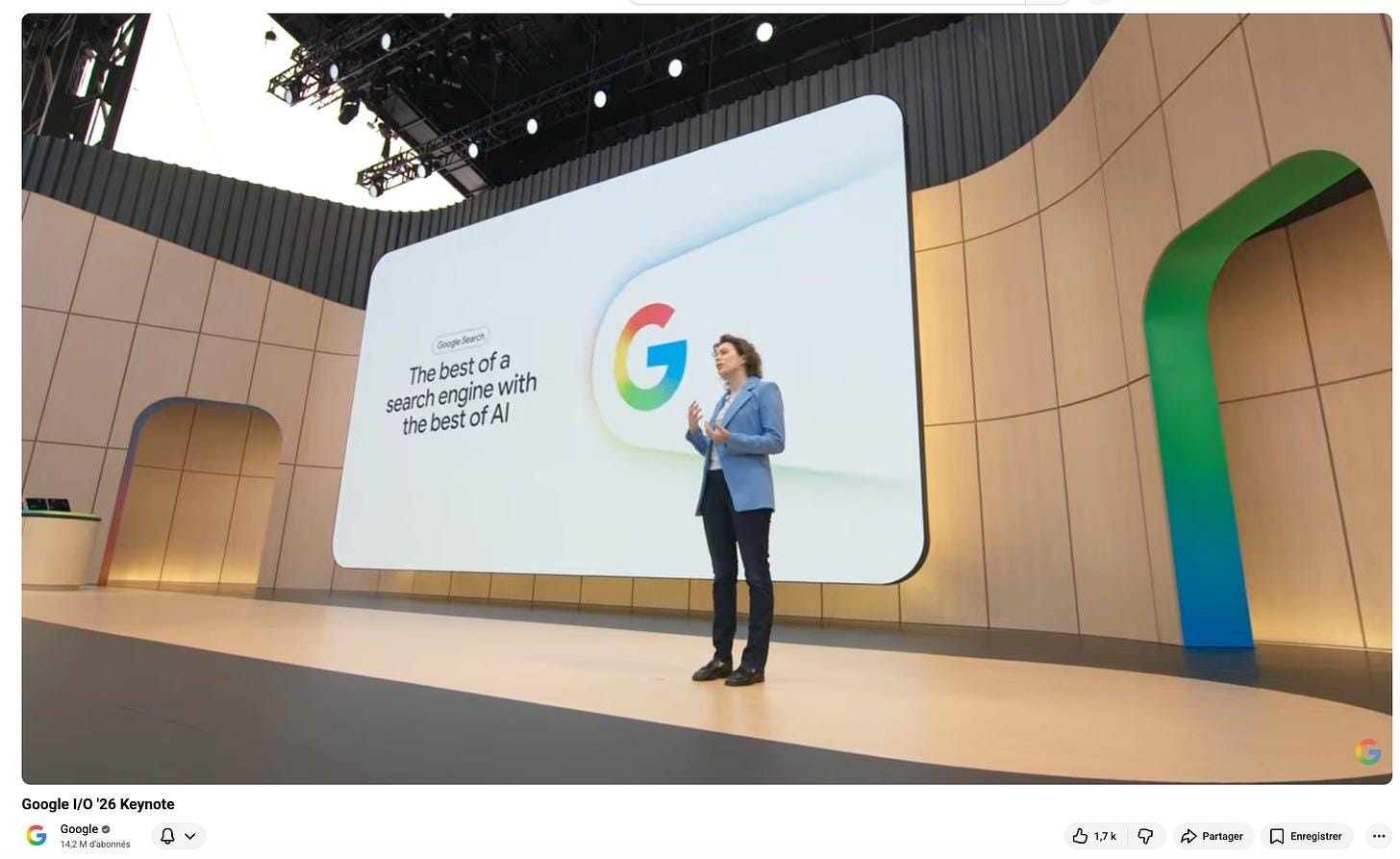
The Best of a Search Engine with the Best of AI
People bring billions of questions to Search every day. Sometimes the whole world is looking for the same thing, but most of the time, questions are as unique as the people asking them (the era of hyper-personalized Search is clearly here).
So the goal is clear:
→ to bring together the best of a search engine with the best of AI.
This transformation began with AI Overviews two years ago.
AI Mode was launched on the I/O stage last year and is now Google’s most powerful AI Search experience, integrating the most advanced Gemini models (and honestly, AI Mode may become Google’s default engine in 2027...).
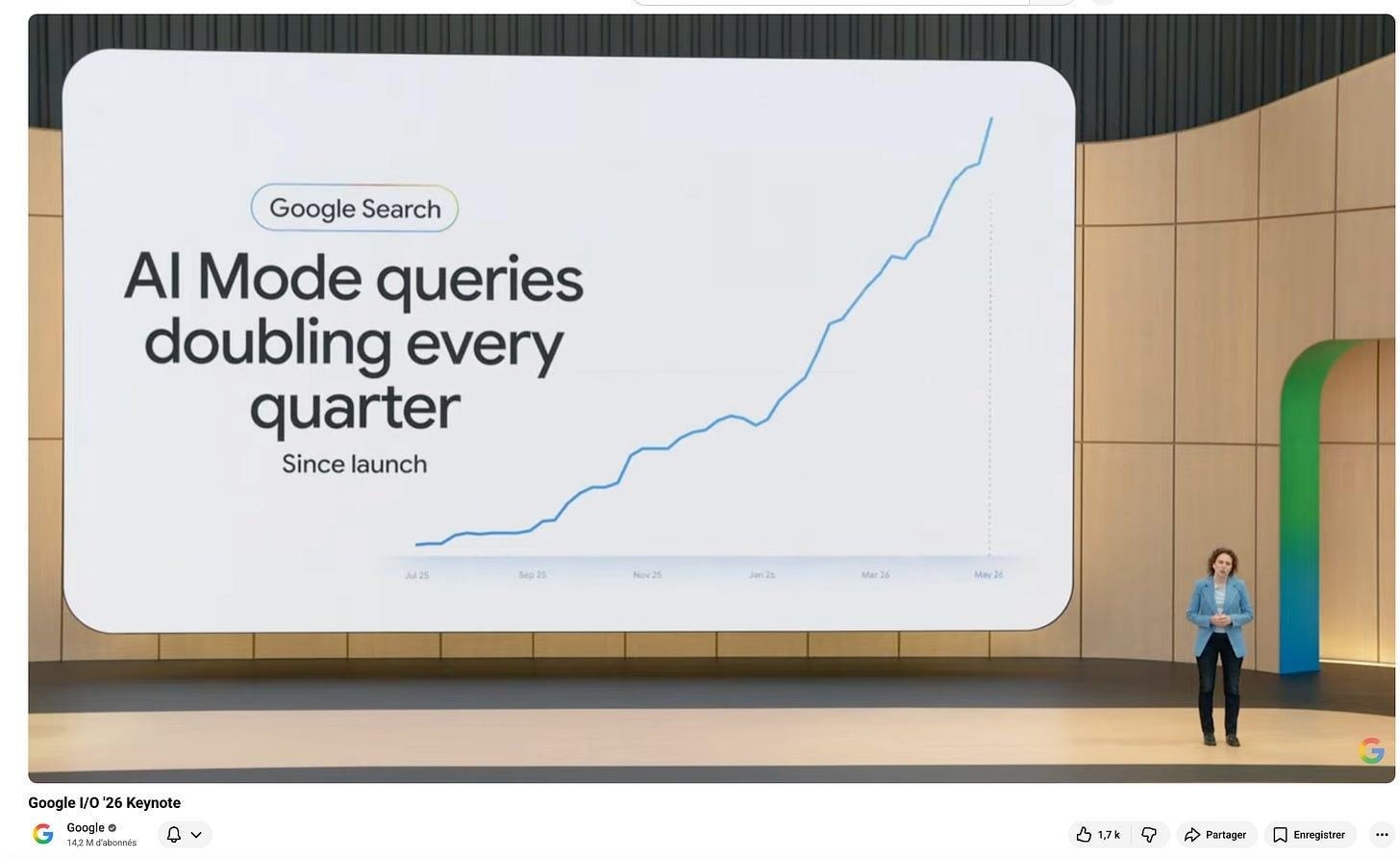
AI Mode queries more than double every quarter.
Starting today, AI Mode is being upgraded to Gemini 3.5.
1️⃣ A New Chapter of Search
Google is entering the next chapter of Google Search.
AI features are no longer just in Search -
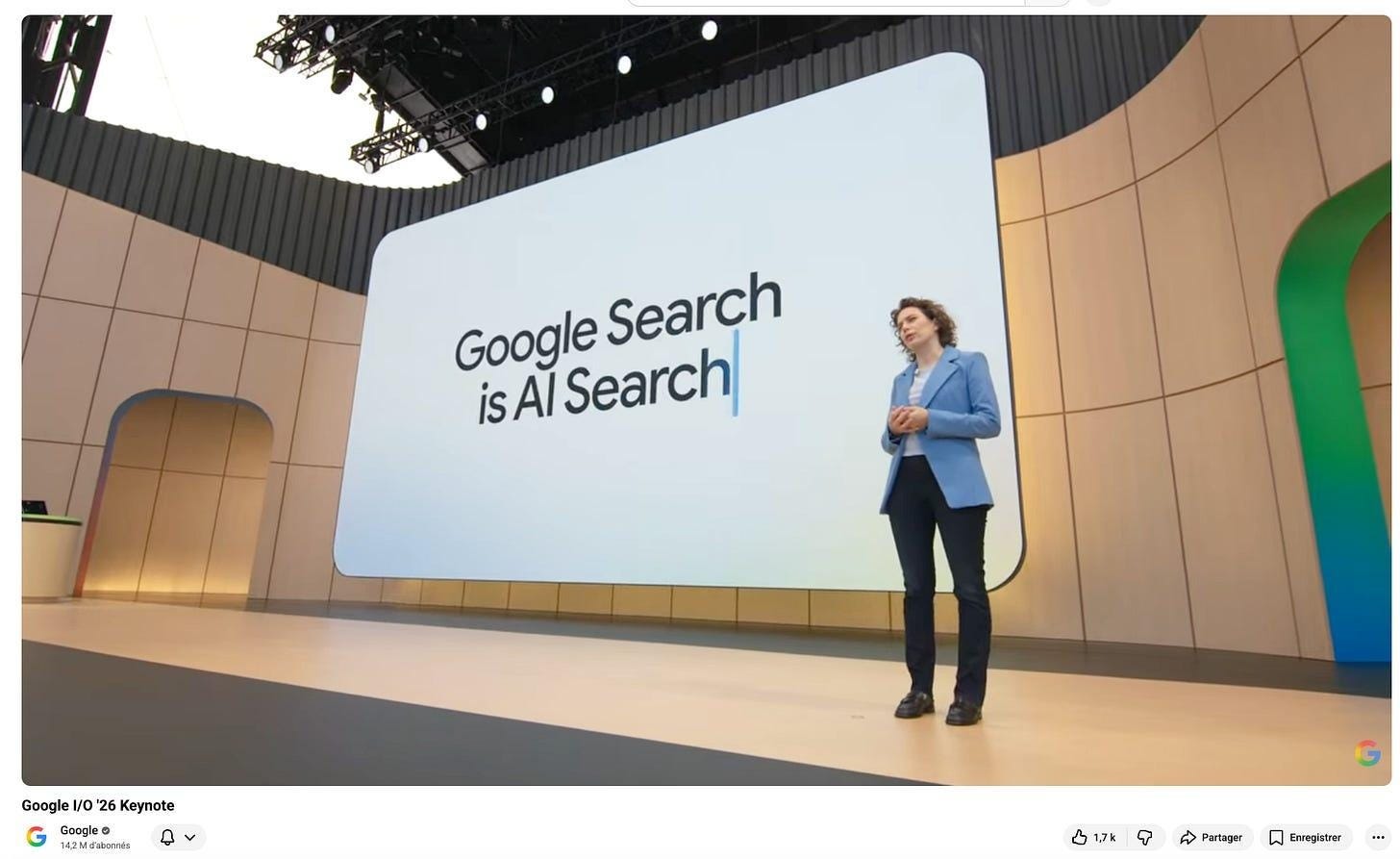
Google Search is AI Search from end to end (Liz Reid).
This AI Search brings together:
the most advanced Gemini models,
the latest agentic capabilities,
and the full breadth of the world’s information.
More than one billion facts updated every minute. Billions of new web pages indexed every day. Connection to an endless range of human perspectives.
Whatever is in your head, you can come to Google and truly ask anything.
2️⃣ New Intelligent Search Bar
One of the “sexiest” new features.
The one that takes us from “Search on Google” to “Ask Google”: the launch of a brand-new intelligent search bar.
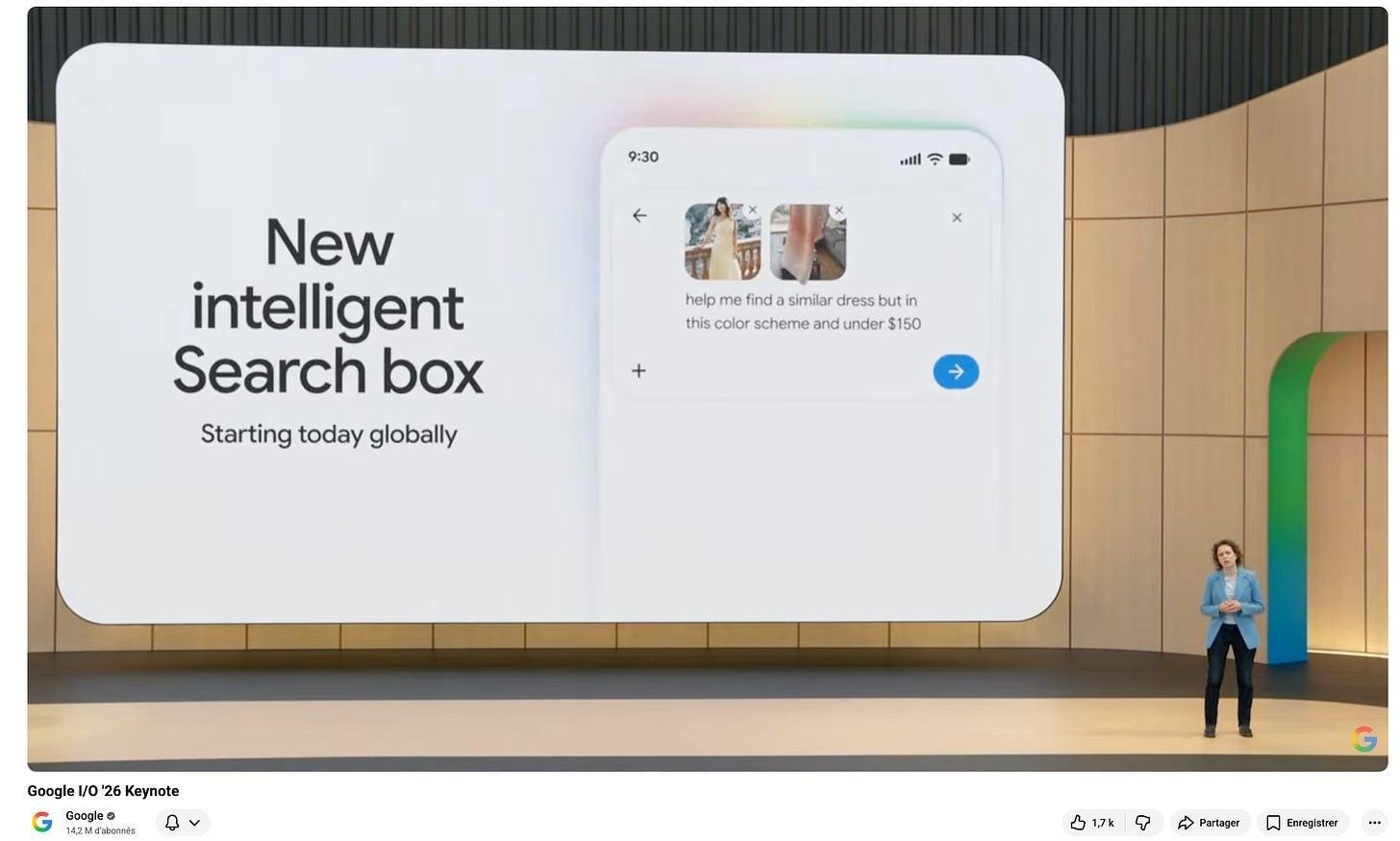
Before: the search bar was a contained space.
Now: it is completely reimagined with AI.
“Ask Search” helps us formulate our questions with AI-powered suggestions. It goes beyond autocomplete: it is nuanced, helping us move from a vague question to a more precise formulation.
The new bar gives us access to the full power of Google’s AI tools: we can “ask Google” across modalities - text, images, files, videos. Search reasons across all these modalities.
Clearly, this is the biggest upgrade to the search bar in 26 years.
→ Expected release date: Today!!
3️⃣ Unification of AI Overviews + AI Mode
Google is making it easier to continue the conversation with Search by bringing AI Overviews and AI Mode together into one fluid AI experience.
We can move effortlessly from our questions to the answer on the main results page, then to a follow-up in AI Mode. Our context follows us.
As the conversation deepens, the links and resources become even more relevant.
→ Expected release date: New experience live today, on mobile, worldwide (except France for now).
4️⃣ Say hello to “Search Agents”
Google is taking a major step toward the agentic vision and entering the era of “Search Agents.”
In other words: the big slap-back answer to Claude Cowork and Code.
We will be able to create and manage multiple AI agents for our many topics directly inside Search.
To start, we will be able to put “information agents” to work 24/7 in the background: they will find exactly what we need, exactly when we need it, and help us take action.
We will then be able to launch multiple agents simultaneously in Search, working alongside Gemini Spark (the latest version of the model).
The demo used a finance example: you ask for major biotech stocks with P/E under 15, positive cash flows, and low debt. The agent takes this highly complex question, creates a plan, determines urgency, identifies the information that is truly needed, adds triggers to monitor changes, and chooses the right tools and data streams. It connects to real-time financial data to get prices and insights down to the second. When it is finished, it sends a smart, synthesized update that helps separate signal from noise. It also points to highly relevant context: crowdsourced research platforms, news sites, and social networks.
Secondary benefit: a big boost for site creators, helping their fresh content be discovered by the people who are truly interested in it.
→ Expected release date: This summer.
5️⃣ Generative UI: When Search Builds the Ideal Interface for Every Question
The best version of Search is the one created just for you - the one that presents information in the most useful format for the question being asked. Hyper-personalization of Search at its maximum.
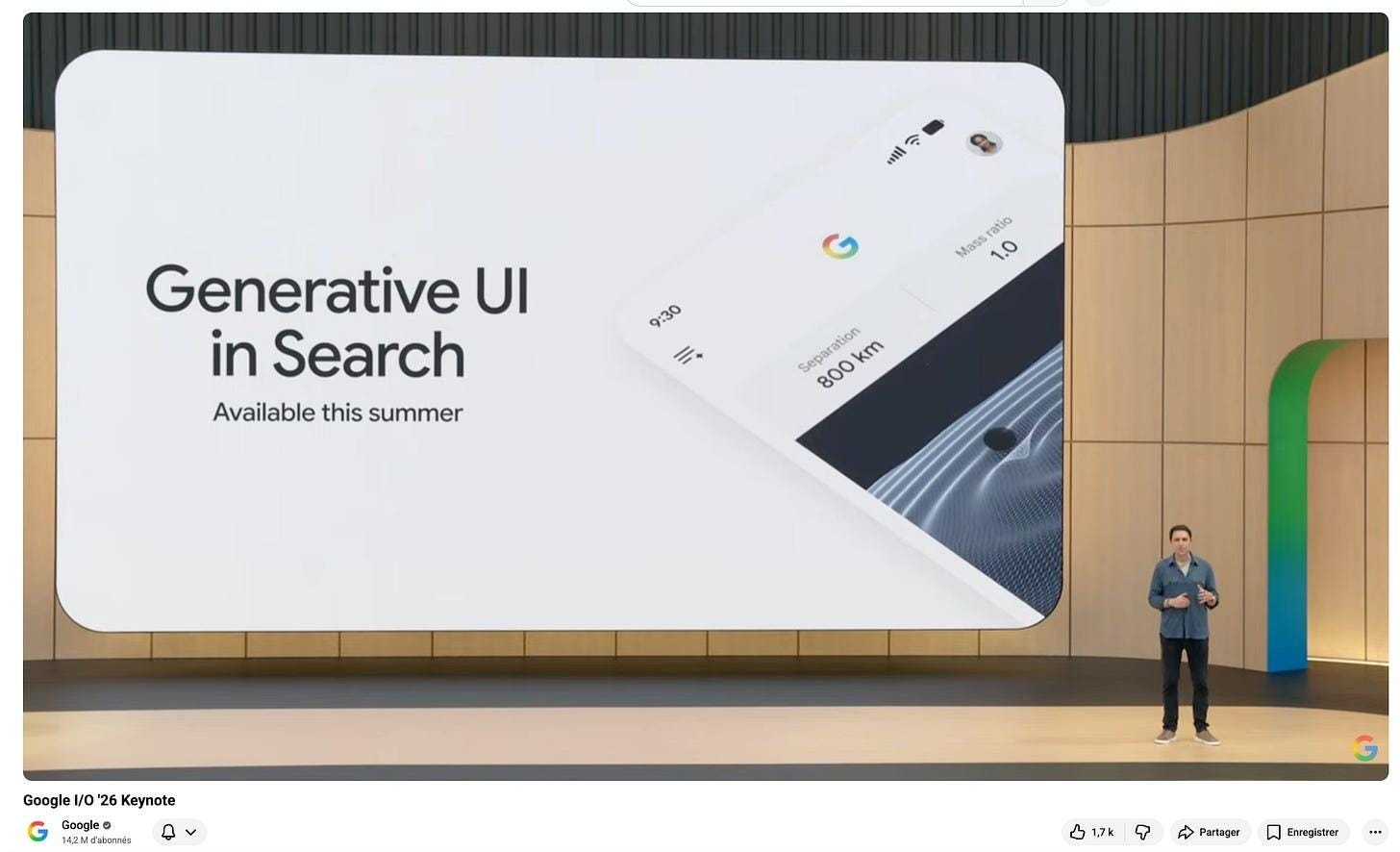
Google has spent years perfecting this: products for shopping, charts for data, visuals for inspiration.
It is now taking a leap by bringing Gemini 3.5 Flash’s agentic coding directly into Search, which can now build the ideal format on the fly - dynamic layouts, interactive widgets, entire experiences, fully personalized.
Agentic coding at Search scale.
The demo (astrophysics) was great: a college student asks, “How do black holes affect space?” Search returns an interactive visual directly in the AI Overview - because such a complex concept is better understood by interacting with it. Follow-up question: “Show me how two binary black holes create gravitational waves.” Google Search generates a dedicated simulation where you can adjust orbital separation and mass ratio, see wave patterns evolve, and watch the small black hole spiral around the larger one. Once the basics are mastered, you can move on to resources and the LIGO discovery papers.
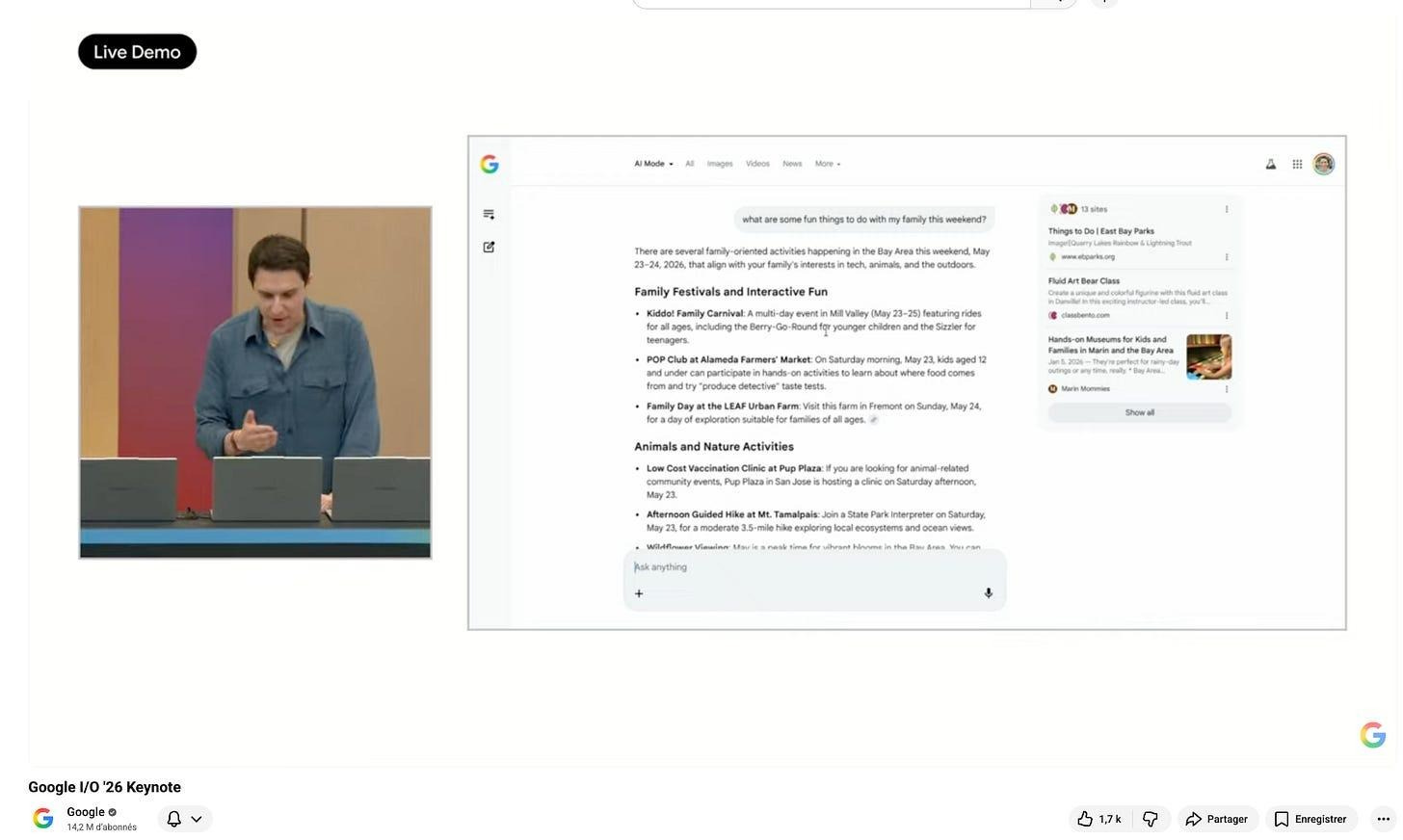
Under the hood.
How do you build a personalized UI for billions of unique questions?
With Gemini 3.5, Search plans the ideal answer from scratch, chooses the components to build, performs search fan-out, then deploys the code. Everything is orchestrated by an Antigravity-powered coding agent, capable of reading, writing, and executing code in a secure container - the same technology that was used to build the OS.
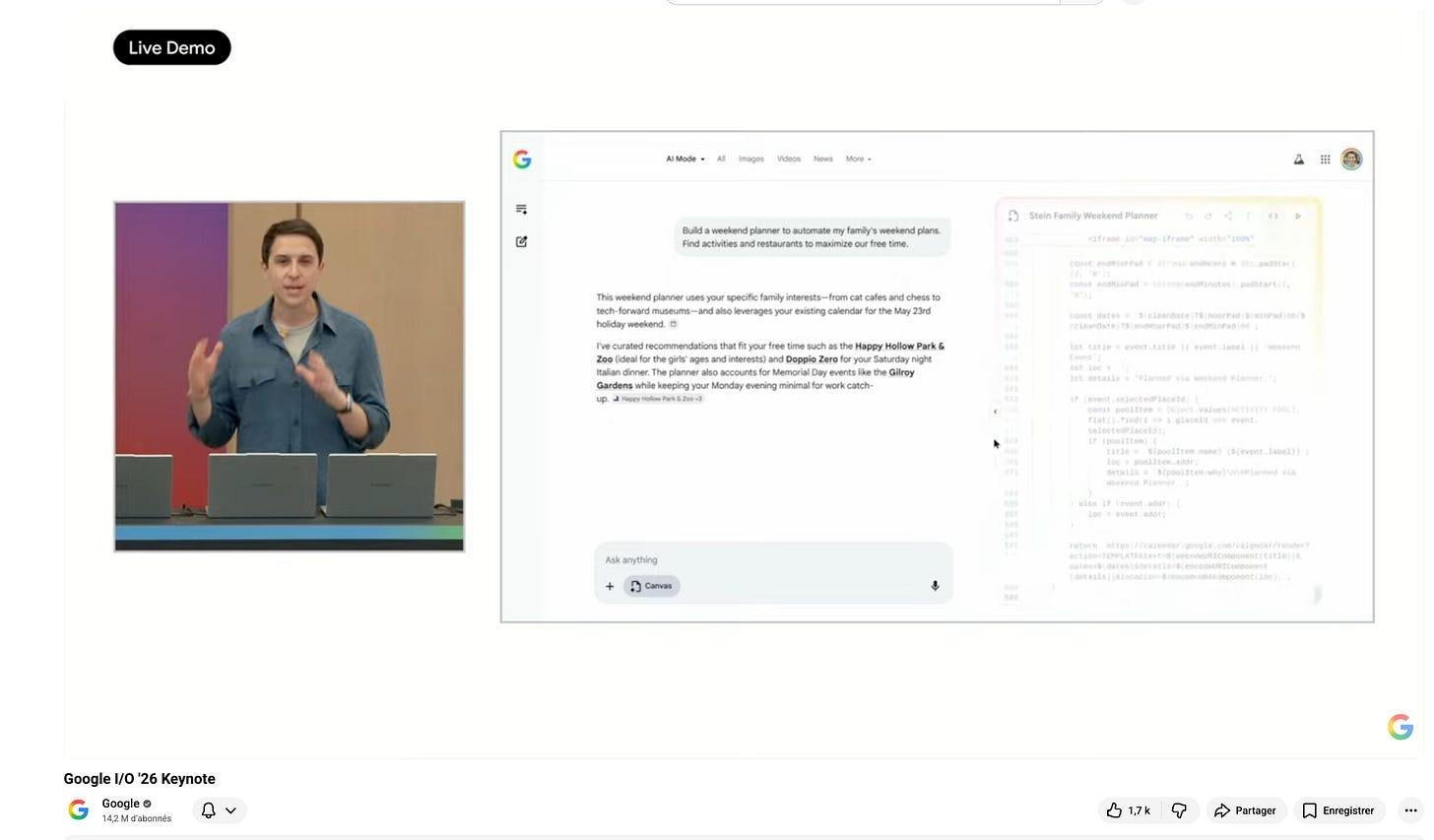
Mini-apps.
Some projects are not one-off questions, but recurring tasks. Google Search can now create persistent experiences - tools, trackers, dashboards - like real little personal mini-apps. Ideal for long tasks such as planning a wedding or managing a move.
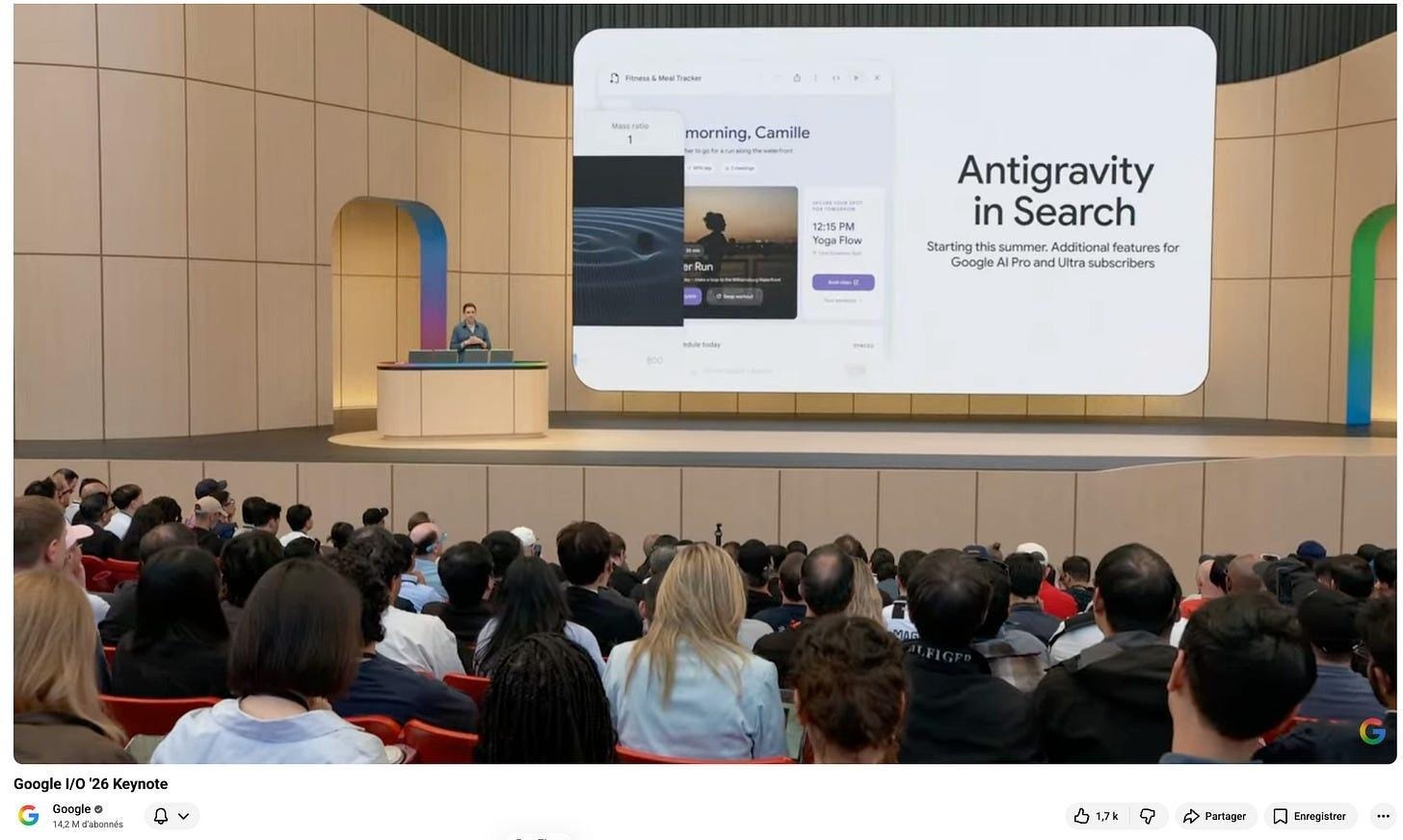
→ Expected release date: Generative UI with Antigravity is coming to Search this summer, free for everyone.
Conversational Search: Google Moves Up a Gear!
1️⃣ Ask Maps
The biggest redesign of Google Maps in a decade.
The promise: to allow people to ask complex and much longer questions in natural language.
Pichai cited a real query sent by a parent: “My tie just fell into the duck pond, and the wedding starts in 30 minutes. Where can I walk to buy a new tie?” He concluded, teasingly: “I’d really like to know how that ended.”
👀 My Take:
I tested this again recently for a client. Optimizing a Google Business Profile with all the right content is one of the first things you should do for your visibility in AI (at least Google’s AI systems). Even if you are a solopreneur without a storefront, optimize your Google Local Pack presence. Google is clearly pampering this Search feature even more this year. You should do the same.
2️⃣ Ask YouTube
This is the feature that completely reinvents video search (my favorite).
Pichai set the scene: “People come to YouTube every day to ask many questions. There are many great videos, but sometimes it is hard to know where to start.”
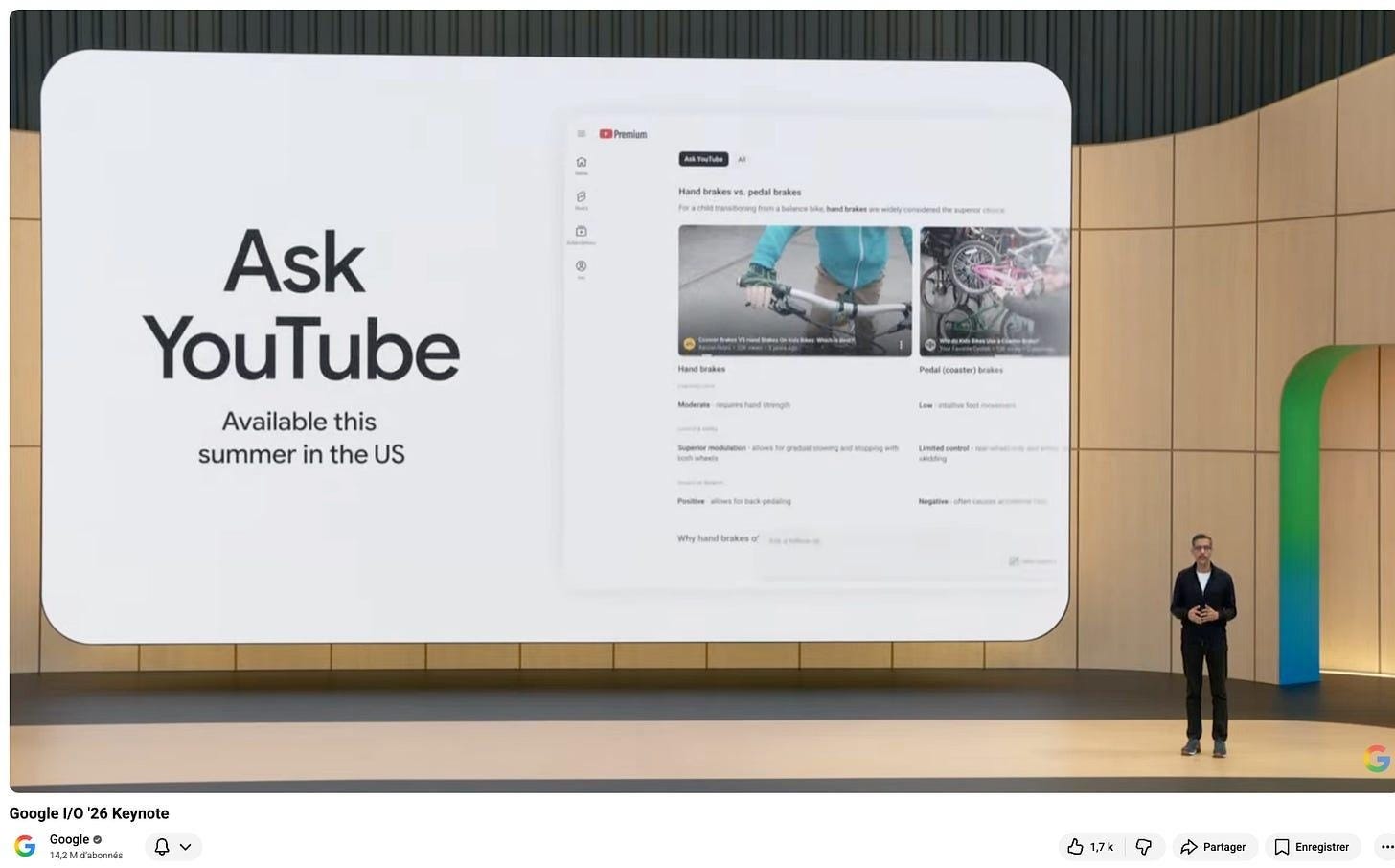
The demonstrated scenario: teaching a child to move from a balance bike to a pedal bike.
In concrete terms, Ask YouTube changes everything compared with classic search:
The information is digested and easy to browse.
You get an overview and useful advice.
You see the videos that best match your interest.
If you want to try a specific teaching method, you can go deeper.
Most importantly: Ask YouTube takes you directly to the most relevant part of the video.
Context memory turns search into a continuous conversation:
you can follow up with a question like “should I buy a bike with hand brakes or coaster brakes?”
The information is even displayed in a table to make comparison easier. Pichai added a personal note: “It reminds me of when I was teaching my kids to ride a bike.”
→ Expected release date: testing underway, with a broader launch in the United States this summer.
👀 My Take:
If you were still wondering whether you should turn your podcast into video, or whether you need a video version of your written content... here is ONE MORE confirmation that now, it is urgent!!
3️⃣ Docs Live
Pichai set the context: we have seen many conversational text queries, but often we want to move things forward “at the speed of speech.”
This is made possible by technical advances and audio models.
Google is taking a big leap with Docs Live.
Before Docs Live, you had to type a precise prompt to create a document with Gemini.
Now, you simply verbalize what you have in mind, and Gemini does the rest. Important detail from Pichai: “everything is in real time, with no acceleration.”
The demo, presented by a member of the product team:
She is preparing a talk for her high school Career Day the next day. First voice prompt:
“I wrote down a few points to explain what I do as a software engineer, but I’m not really sure where to start. Can you pull my resume from Drive? That said, it might be boring. Can you find some fun analogies to make it more engaging for the students? Also, I think the school sent me an email - the subject should look like ‘Career Day Logistics.’ Pull the details and put them at the top of the doc.”
Then she iterates, still by voice:
“This is cool, but it’s a bit dense. Can you format the analogies as a table? And add a note near the top of the document so I remember to tell the story about my brother who inspired me to become a software engineer.”
What the demo shows, point by point:
Document creation by voice, in real time.
Automatic retrieval of information from Drive (the resume) and Gmail (the school email).
Voice-driven formatting (tables, bolding, hierarchy).
Iterative editing in natural language.
Eventually, we will even be able to “create documents and edit them directly, all by voice.”
→ Expected release date: Docs Live arrives this summer for Pro and Ultra subscribers. The same voice capabilities will then come to Gmail and Google Keep.
👀 My Take:
ABSOLUTELY HUGE!!!
Agentic Commerce Integrated into Search
1️⃣ Universal Cart
An “intelligent” multi-merchant cart accessible from Search, Gemini, YouTube, and Gmail. It detects product incompatibilities and finds hidden savings through Google Wallet.
As soon as a product enters the cart, the cart starts working in the background: it tracks good deals, gives insights into price history, and alerts you when an out-of-stock product is back in stock.
The real leap → intelligent reasoning.
Example cited: you are building your first custom PC; you add a motherboard that seems perfect - but you had not realized that the processor already in your cart uses a different socket. Universal Cart detects the incompatibility and suggests an alternative, preventing a problem you had not seen coming.
Another highlighted feature → hidden savings detection.
If, like most people, you have several payment cards with different rewards programs that are hard to track, the cart uses Google Wallet to do it for you -
Example given: a Target offer on products already added.
For checkout → two options:
Pay directly on Google in just a few taps with Google Pay,
Or send everything to the retailer to finalize there.
→ Expected release date: this summer in the US on Search and Gemini, followed by YouTube and Gmail.
2️⃣ Universal Commerce Protocol (UCP)
Google’s analogy is direct: “What HTTP did for the web, UCP does for agents.”
It is an open-source standard that gives all players (merchants, agents, platforms) a common language to maintain trust throughout the shopping journey: product search, checkout, shipping tracking, and returns.
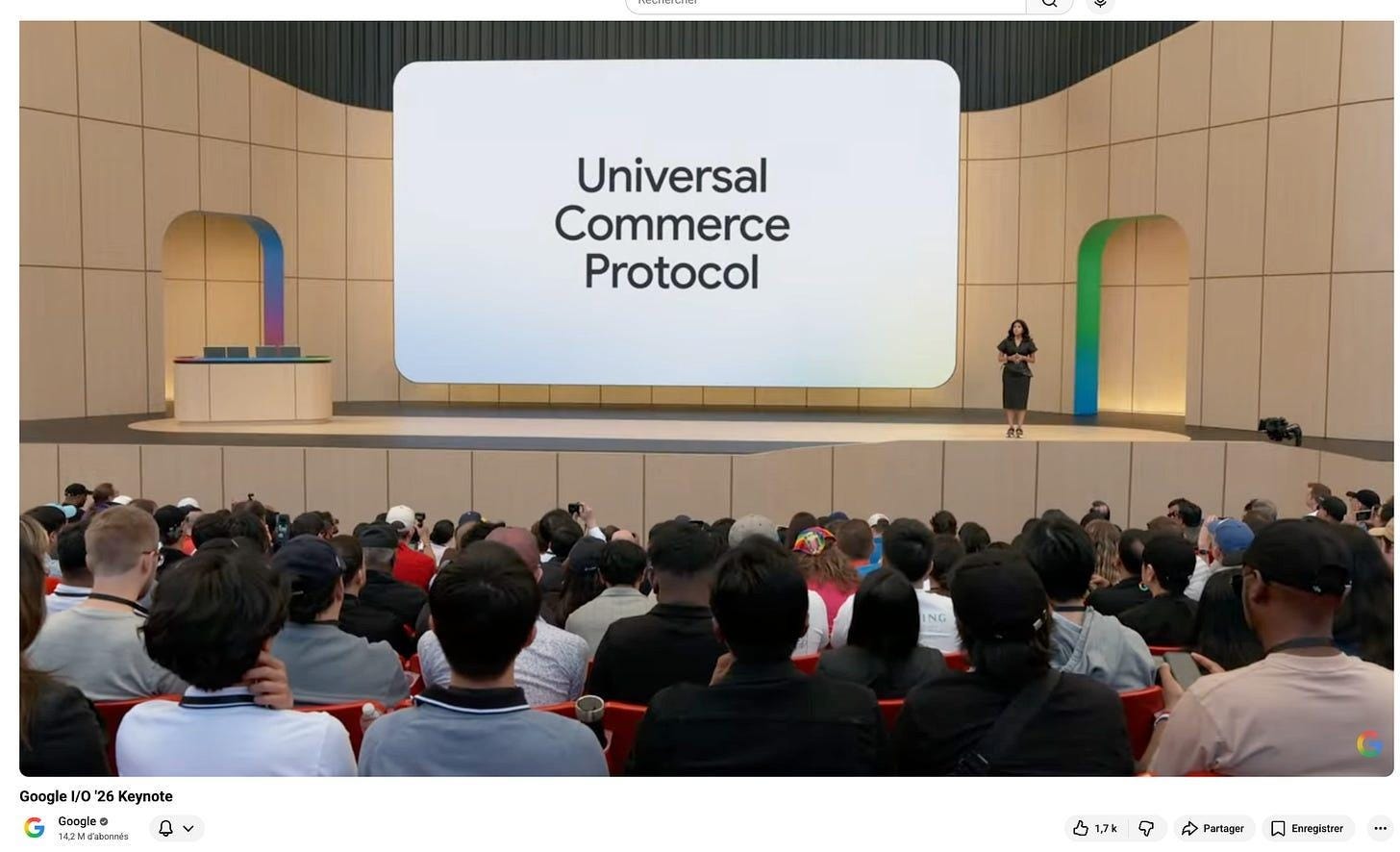
The protocol was launched with a group of founding partners - and Google noted in passing that it may be “the first time we all agree on something.”
UCP is now expanding to new verticals (hotels, local delivery) and new countries (Canada, Australia, United Kingdom).
→ Expected release date: in the coming months.
3️⃣ Agent Payments Protocol (AP2)
A secure payment protocol for AI agents, with user-defined limits and cryptographic traceability.
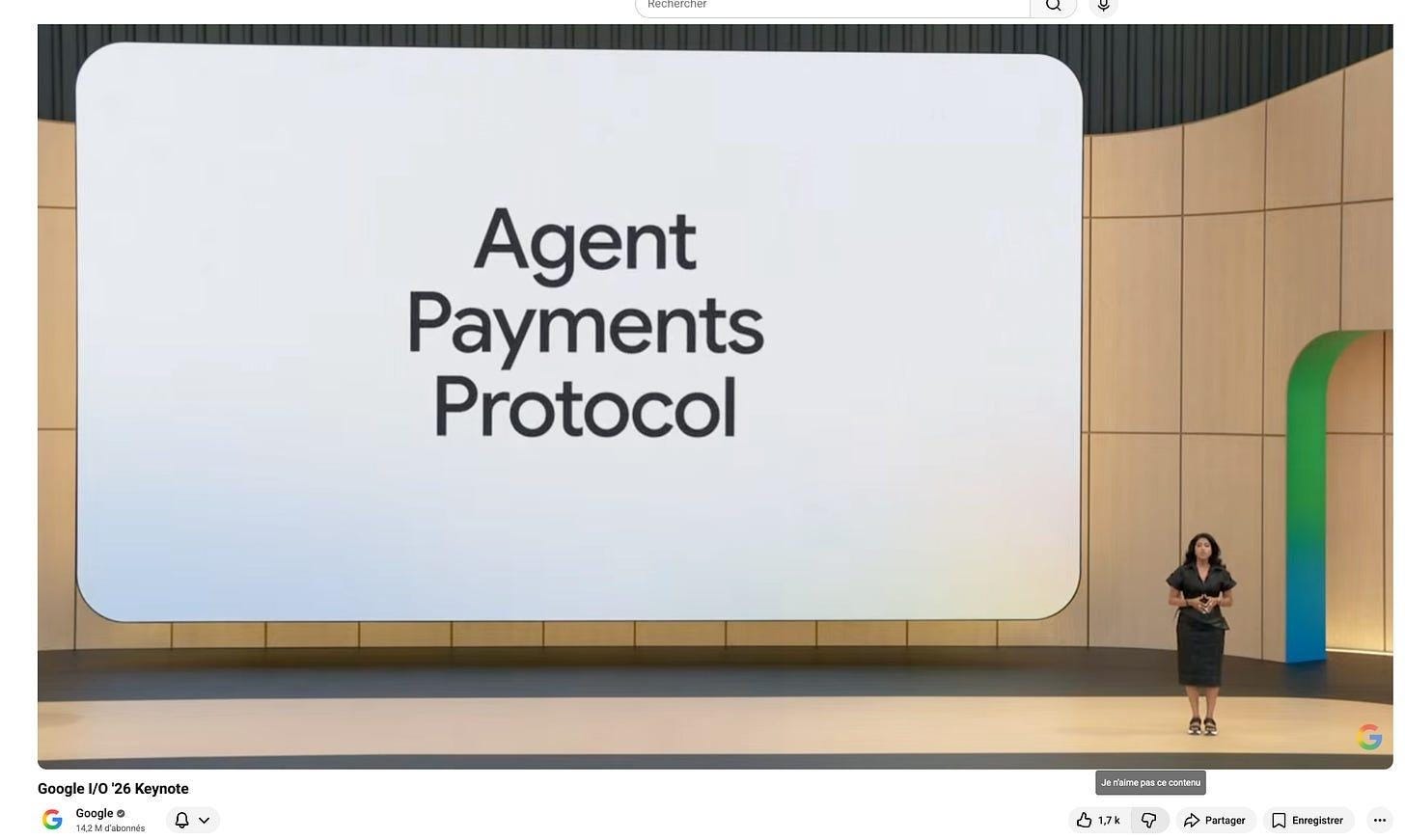
The number one question Google hears about agentic payments:
“How can I be sure the agent will not go off and buy something I do not want?”
AP2 is the answer.
The protocol is built on two principles:
Limits. The user tells the agent which specific brands and products are authorized, as well as the budget. The purchase is triggered automatically if - and only if - the criteria are met.
Accountability. AP2 creates a transparent, verifiable link between the user, the merchant, and all payment processors. Through cryptographically signed digital mandates, the agent always acts on behalf of the user, and every transaction leaves a permanent digital paper trail. In the event of a return, the user and the merchant look at exactly the same record. All of this uses privacy-preserving technology to keep payment data secure.
→ Expected release date: in the coming months, first through Gemini Spark.
👋 That’s it for this special edition. Between two workshops and a major family event tonight… I’ll be putting together a full debrief edition for you next week. Which format would work best for you?
Thank you so much, Karine, for the insight. The new functionalities are incredible! We can expect delays in Europe due to regulations, and in France, we still don't have AIO because of discussions about the remuneration of press editors.