
🟣 The AI Content Strategist [12/03/2026]
Your monthly briefing on AI Search and Geo. For decision-makers who don’t have time to scroll through LinkedIn or Google for 4 hours a day 😉. News, strategies, tactics, tech, stats, research, tools.

👋 I’m Karine. I help you design your content strategy in the age of AI Search and Geo. In this month’s newsletter you’ll find:
🟣 Top AI Search News – The 4-5 Major News Stories of the Month
🟣 Top research & data – Studies/research that will help you
🟣 The AI Search tech corner – Tech for non-techies
🟣 Search Everywhere Optimization – Beyond Google
🟣 GEO Strategies – GEO strategies for the C-suite
🟣 GEO Tactics – Expert Field Tactics
🟣 SEO vs GEO – The naming war continues
🟣 AI Search Tools – The tools that matter (mostly free)
Let’s go 👇 .
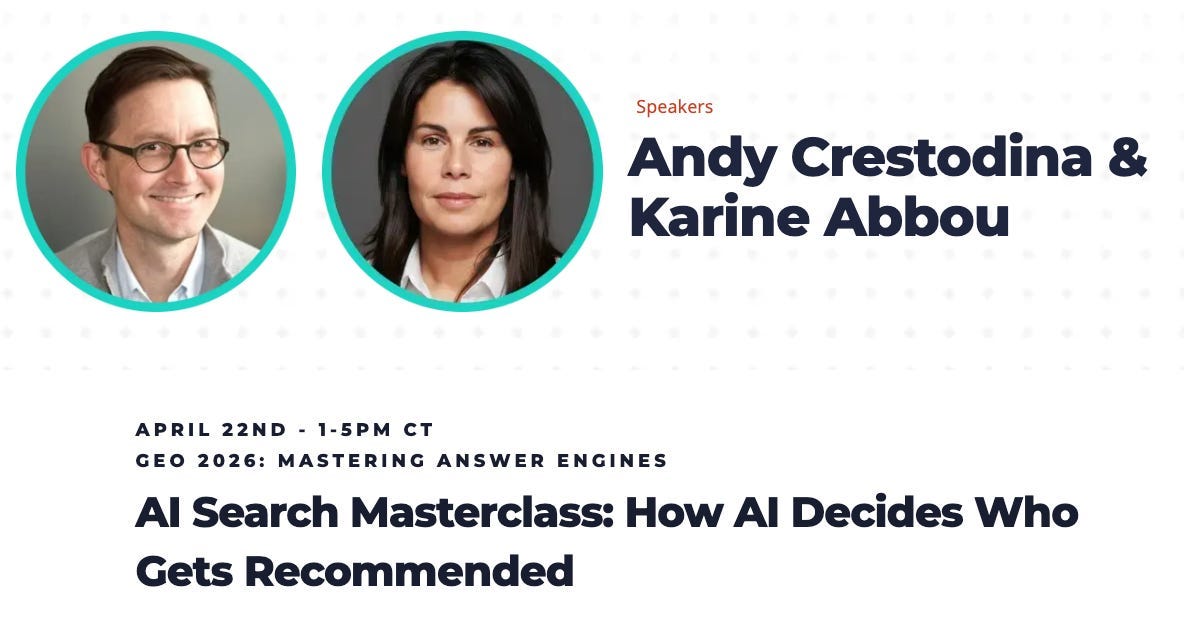
AI Search Masterclass - Join Andy Crestodina (and me 🥳!!) Live at Content Jam 2026.
On April 22nd, I’m in Chicago for something special. I’m joining Andy Crestodina Andy Crestodina and Orbit Media Studios Media to lead a 4-hour deep dive on the most important topic in marketing right now: “AI Search: How AI Decides Who Gets Recommended”.
No fluff. Just 4 hours of tactics and strategy on how to ensure AI (Gemini, ChatGPT, Perplexity) actually know—and cite—your brand. It’s happening in the best city in the States, at the best lead-gen agency in the business. Are you joining us? 🙌.
🔥 Top AI Search News
The 3-5 game-changing AI Search news stories this month
🟣 Profound raises $96 million. GEO officially becomes an industry
This unprecedented investment for a startup barely 18 months old in the still-nascent GEO industry validates agentic web technologies as the critical infrastructure for tomorrow’s marketing. Following Adobe’s acquisition of Semrush, this funding round seals the deal. We are officially in the era of agentic marketing.
🟣 Advertising is coming to ChatGPT. And it’s outrageously expensive.
Sam Altman is positioning himself as Robin Hood — “AI must be accessible to everyone.” A rich sentiment, considering OpenAI committed $1.4 trillion to infrastructure over eight years, largely funded by Microsoft. From a business perspective, the model is hard to defend: $60 CPM, with no conversion tracking. You’re paying a high price for a promise that no one — not even OpenAI — can quantify. Quite a statement…
🟣 Cloudflare is trying to invent a two-speed web (at your own risk)
Cloudflare launches Markdown. And let’s be honest, it’s not exactly a groundbreaking invention. They’ve simply formalized—on a massive scale— a practice as old as SEO itself (which used to be categorized as Black-Hat and Google officially classifies as Spam ): showing one version of your site to humans, and another to machines. Before, the machine was Google. Today, it’s AI agents. Same game, new players. And Google’s disapproval? Not really a surprise either.
🟣 Bing does what Google refuses to do: show you how AI cites your content.
Pause. A search engine has just created the first official GEO measurement tool in history. This isn’t just a small piece of news. It’s institutional validation that GEO is a real discipline —with real metrics and a real dashboard. No longer just a trend among SEO geeks, it’s a measurable economic reality. And it’s a kick in the hornet’s nest of opacity that has reigned for the past two years over AI visibility… made by Google.
👉 Full details here + The 7 other AI Search news stories of the month to bookmark.
📊 Top AI Search Research & Data
Studies and data that are redefining the game
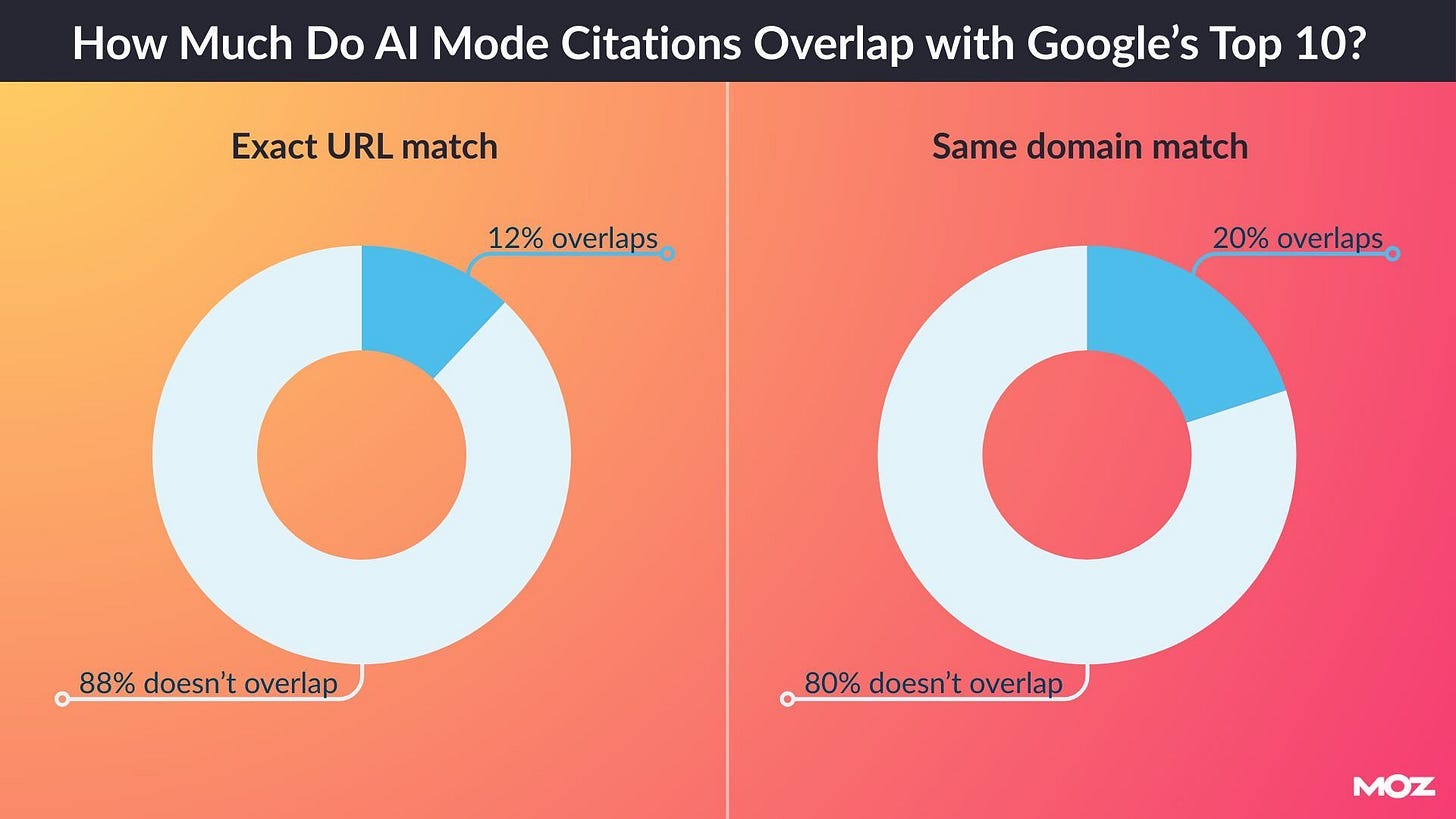
🟣 AI Mode only cites 12% of URLs that rank in traditional SEO — what those changes for your strategy.
It’s Moz’s February study that’s generating the most buzz in the community. The verdict is stark: only 53% of the domains cited in AI Mode correspond to Google’s organic Top 10. And according to Moz, only 12% of the URLs cited in AI Mode match the URLs that rank in organic SERPs.
In short: ranking well on Google is (really) no longer enough to be considered in AI Mode. They are two different games, with different rules.
👀 My 2 Cents:
What this confirms from a GEO perspective —> content depth, readability, and freshness matter more than traditional SEO metrics like traffic and backlinks for obtaining AI mentions and citations. And most importantly: AI Overviews and AI Mode cite different sources — only 13.7% overlap between the two. What does this mean in practice? I’ve already written about it, and I reiterate it in my masterclass: don’t manage your AI Mode visibility and your AI Overviews visibility as a single project. They are two distinct targets that require two distinct content approaches.
📎 Moz Blog
🟣 ChatGPT requests have doubled in length in 4 months
When you type a prompt into ChatGPT, it doesn’t send it directly to a search engine. Instead, it breaks it down into several independent mini-queries—query fan-outs (QFOs)—to retrieve specific information and construct its response. Peec AI has just confirmed this with 20 million QFOs: between October 2025 and January 2026, the average length of these queries doubled, increasing from an average of 6 words to 12. This trend was consistent across all countries and languages.
What remains unchanged, however, is the number of queries per prompt, which remains stable (between 2 and 3). ChatGPT doesn’t search more—it searches better. Each query becomes more precise, more contextual, more specific.
👀 My 2 Cents:
This is important for your AI Search strategy because the sources cited in AI responses are no longer those that match a generic keyword— they are those that answer a highly specific question. Broad-spectrum content is losing ground. Precision content—detailed product pages, in-depth FAQs, concrete case studies—is gaining ground. In practical terms: if your content doesn’t answer a very specific question, ChatGPT simply won’t find it.
📎 ChatGPT fan-outs have doubled in length in 4 months
🟣 The State of Content Marketing in the Age of AI: What the Numbers Say
First, some good news: 81% of marketers are optimistic about the future of content marketing in the age of LLMs; and 67% see AI as an opportunity, not a threat. This is a welcome change from the prevailing catastrophism of “AI will put us all out of work.” This is the conclusion of a joint study by Clutch & Conductor of 459 marketing professionals surveyed in January 2026. So, that’s that. Now, some of the figures are still quite thought-provoking.
25% of teams report that LLMs are now their primary audience. This figure rises to 32% in large companies (over 500 employees). AI is no longer a secondary channel—it has become a fully-fledged editorial target. And yet, 74% of organizations still primarily target human users or traditional search. The gap between awareness and action remains massive.
87% of marketers anticipate an increase in their content budget in 2026. The number one priority, for both teams and management, is reputation management (41%). It’s no longer about “generating traffic”—it’s about “controlling what AI says about us.”
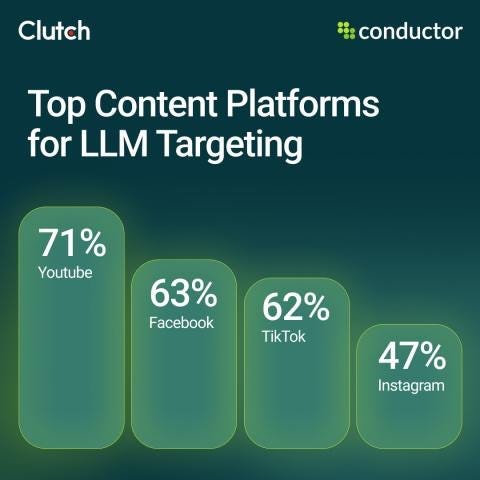
52% of teams will increase their video investments for LLM visibility. YouTube is emerging as THE priority platform, both for reaching humans (70%) and for being cited by LLMs (71%). And 27% of marketers rely on proprietary studies and reports to improve their AI visibility—precisely because original data is what LLMs cite most often.
Traffic remains the king of KPIs (41%) (unfortunately) — but Ann Handley makes it clear: traffic alone is misleading in the age of AI Search. It needs to be combined with a second metric: citations, conversions, brand lift, and returns. Because influence can now exist without clicks. And clicks are decreasing anyway, becoming much more qualified (that’s my own observation), and in fact, the next search directly addresses this topic 👇 .
👀 My 2 Cents :
This report confirms what I’ve been saying for months: the battle for visibility is now being fought on two fronts simultaneously —humans AND machines. Convincing humans that AI is disrupting the traditional fundamentals of content strategy; and enticing AI to recommend what we’re selling. Companies that understand this are restructuring their teams, budgets, and KPIs accordingly. The others continue to optimize for a world that will soon be obsolete.
📎 State of content marketing in the age of AI
🟣 AI doesn’t do SEO. It does closing.
1.96 million LLM sessions analyzed over 12 months (Nov. 2024 → Nov. 2025), across 6 different sectors (SaaS, e-commerce, finance, healthcare, legal, publishing). What AI traffic reveals about the future of search — and which pages convert.
The surprising figure (which nevertheless says it all) – AI traffic represents only 0.13% of total sessions — or 1 visit out of 769. Negligible? Not at all. Cloudflare’s CEO quantified it: getting a referral click from OpenAI is 750 times harder than from the traditional web. What emerges from LLMs is therefore deliberate, intentional, and highly qualified.
ChatGPT is crushing the competition— but watch your back. ChatGPT holds 84.2% of AI referrals, with 3.26x year-over-year growth. But Copilot is exploding at +2,419% (25x) and Claude at +1,180% (12.8x). Why this matters: Copilot lives in Microsoft Office. Claude in dev and pro environments. AI discovery will soon no longer be exclusive to ChatGPT—it will happen where people are already working.
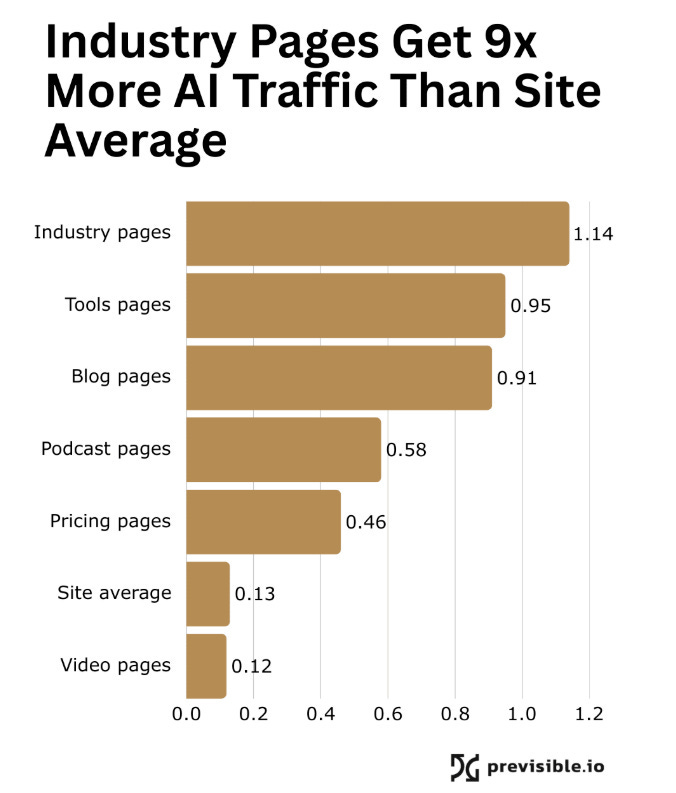
AI traffic doesn’t land randomly— it goes where people decide to buy. In terms of raw volume, search and blog pages capture the most sessions. But in terms of penetration rate (the percentage of total traffic that comes from AI), the hierarchy is quite different: “Industry” pages reach 1.14% penetration (9 times the average), “Tools” pages 0.95% (7 times), and “Pricing” pages 0.46% (3.5 times). The site average remains at 0.13%. What this means is that AI isn’t sending casual browsers. It’s sending buyers in the final comparison phase.
The Pricing Page: AI’s New Playground - 40,756 AI sessions landed on pricing pages over 13 months — often on a single URL per site. This is one of the clearest purchase intent signals in the dataset. When someone asks ChatGPT “how much does [product] cost?”, they arrive on the pricing page with the decision practically already made.
E-commerce explodes during the holidays (+67% in November) – AI penetration in e-commerce jumped 67% in November 2025, rising from 0.11% in October to 0.19%. Year-on-year, this represents a 10.5x increase (from 0.02% to 0.21%). A clear signal: consumers are using AI for their product research when the stakes are highest. Black Friday, Christmas – AI visibility becomes critical precisely where purchasing decisions are made.
YMYL sectors lead adoption – the legal sector is experiencing 11.9x growth, finance 2.9x, and healthcare 2.4x. These are the “Your Money or Your Life” categories – where decisions have real-world consequences. This makes sense: AI excels at synthesizing and comparing complex information. That’s precisely what users in these sectors are looking for.
Each sector has its own discovery journey. In SaaS, 41.9% of AI traffic lands on search pages, then blog (19.9%), then pricing (16.4%)—a classic search path. In e-commerce, 41.1% lands directly on product pages. In healthcare, 38.8% lands on “About” pages—a credibility check before any engagement. There’s no one-size-fits-all geo-optimization strategy. The type of page to prioritize depends entirely on your industry.
Podcasts > Video (for now) - Podcast pages reach 0.58% AI penetration (4.5x the average), while video pages remain at 0.12% (close to the average). Why? Podcasts have transcripts that AI can parse. Video remains difficult to process natively—but with the evolution of multimodal capabilities, this will change quickly.
👀 My 2 Cents:
AI traffic is small but precise—it lands on decision pages, not discovery pages. This is no longer visibility SEO. It’s conversion-driven GEO. The three priority actions for 2026, according to this study, are: 1) Prioritize industry and search pages —they capture over 40% of AI traffic; 2) Optimize pricing pages for AI buyers —make them transparent, scannable, and comparable; 3) Structure content to answer the question, “What should I use?” —AI is a recommendation engine, not a ranking engine. This is precisely what Airbnb is doing and observing .
📎 2025 State of AI Discovery Report: What 1.96 Million LLM Sessions Tell Us About the Future of Search
In my GEO masterclass, I help you redefine your content strategy to move from producing volume (to cover keywords) to a strategy of “source coverage” and relevance engineering. The next session is at the end of March; you can join the waiting list here 👇👇 .
🔧 The AI Search Tech Corner
AI Search for non-techies - 1, 2 or 3 words “SEO tech” explained in basic English 😉
🟣 Robots.txt
Definition - The robots.txt file is a simple text file, placed in the root directory of your website, that tells web crawlers what they are allowed to read on your site. Two lines of code. A colossal impact.
The context – In the age of AI search, these bots are no longer just Google’s. They also belong to ChatGPT, Perplexity, Claude, and Copilot. And if your robots.txt file blocks them – often due to a conservative IT configuration inherited from the past – you simply don’t appear in their search results. CNET has disappeared from ChatGPT’s results. GoodRX is invisible on Perplexity. The reason? Not a hack. Not a sanction. Just a closed door.
The analogy – Imagine you open a gourmet restaurant. You have the best chef in France, a sublime menu, a magnificent dining room. But someone has locked the door and turned off the sign. No one can get in. No one knows you exist. Your robots.txt file is that door. Open or closed. There’s no in-between.
The nuance you need to know – this is the strategic part: there are two distinct types of robots at OpenAI, and the same logic applies elsewhere:
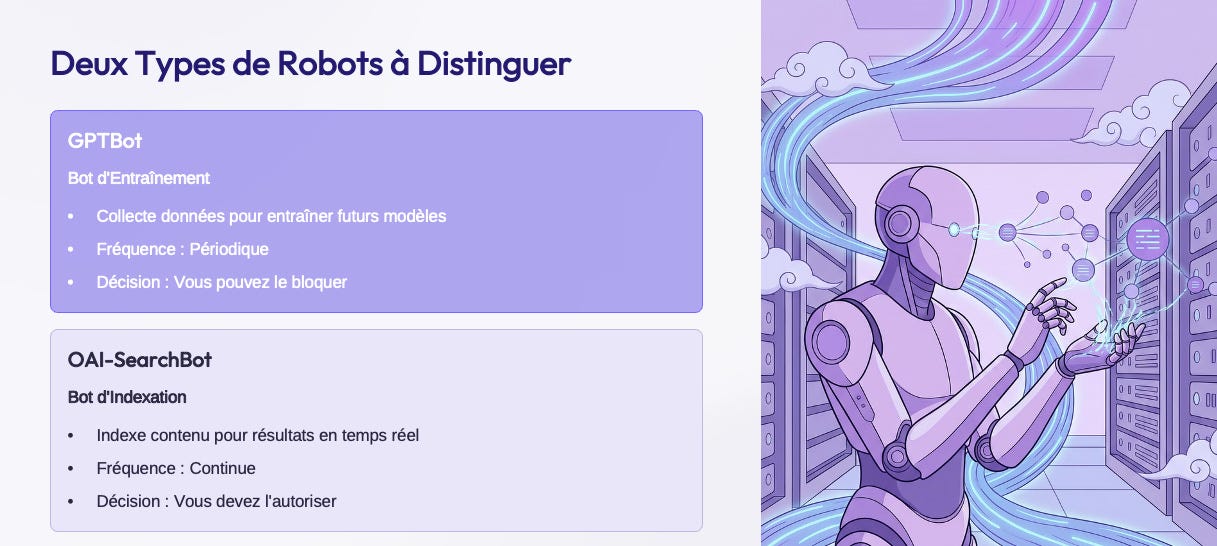
GPTBot → the training robot. It collects your content to feed future models. You can legitimately block it if protecting your intellectual property is a priority.
OAI-SearchBot → the indexing robot. It indexes your content to cite it in real time in SearchGPT responses. If you block it, you disappear from the results. Period.
The good news —> you can block one and allow the other. Protect your IP address and remain visible. It’s the best of both worlds.
👀 My 2 Cents:
This week, here is one business decision to make. Just one action: type yoursite.com/robots.txt into your browser. Check if these agents are blocked: OAI-SearchBot (ChatGPT), ClaudeBot (Anthropic), PerplexityBot, Google-Extended, Bingbot. If any of them appear in a “Disallow” line—you have a problem. Escalate it immediately to the CMO/CDO level. Not to IT alone. IT implements. You decide. Letting a developer block “all unknown bots” as a security reflex in 2025 means letting your competitors steal the most qualified traffic on the market. This isn’t a technical detail. It’s a strategic mistake.
🌐 Search Everywhere Optimization
Optimizing to be listed by Google is no longer enough
🟣 YouTube surpasses Reddit as a source of AI citations – YouTube now appears in 29.5% of Google AI Overviews — ahead of Reddit. The reason is simple: transcripts, metadata, chapters. YouTube is natively readable by LLMs. A recent audit by Brainlabs for an enterprise client found YouTube cited as the primary source in nearly 60% of AI Overviews. Double the average. What LLMs prioritize: Videos of 10 to 20 minutes, fewer than 100,000 views, titles of 8 to 12 words, with high information density. And above all: answers to real questions. A final implication—and this one is explosive for influencer marketing: creator partnerships on YouTube don’t appear in the metadata. LLMs read the transcripts. A creator who naturally mentions your brand in a video becomes a GEO source. The brand deal is now an SEO asset.
👀 My 2 Cents:
If your brand doesn’t have a structured YouTube presence, you’re not appearing in a growing share of AI-powered search results. YouTube is no longer just a “social media” channel; it’s an AI-powered visibility infrastructure. If you haven’t already, you need to get on board.
📎 Digiday — Why YouTube has become key for brand GEO strategies
🟣 75% of revenue generated via LinkedIn by just 2 content formats - Brendan Hufford demonstrates that with 2,241 posts and 18.2 million impressions, just two types of content generate 75% of his revenue: problem-naming (e.g., “checkbox marketing”) which gives a voice to frustrations, and actionable visual frameworks (70/20/10 Content Bet) used practically in meetings. This radical analysis criticizes the pressure on content quantity at the expense of strategic impact and genuine enthusiasm.
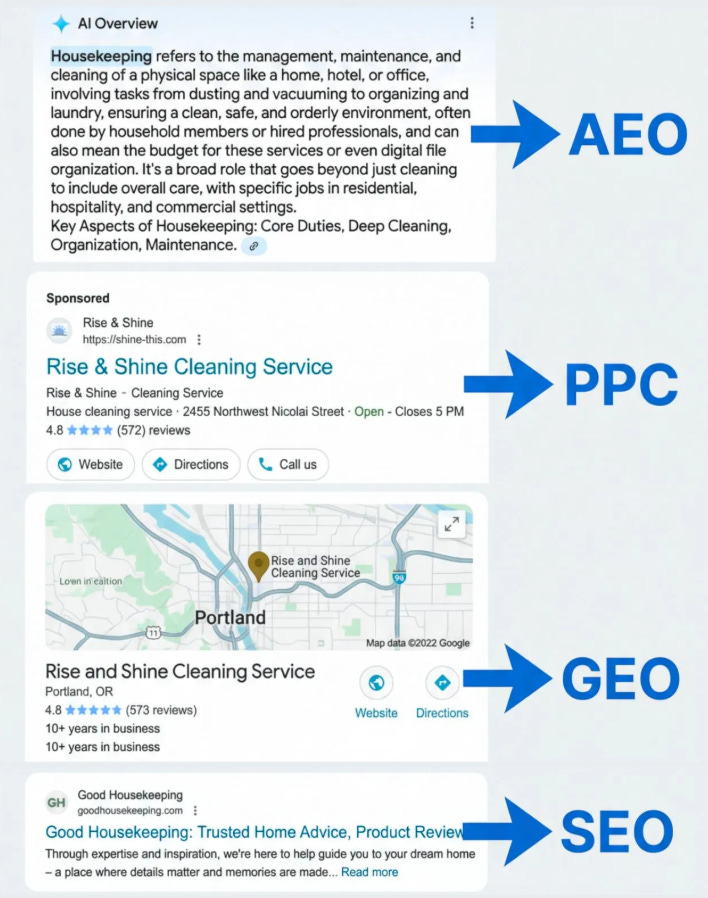
🟣 Being #1 on Google is no longer enough (we know that) – welcome to the multi-layered era of search (we know that too), but… – Anna York exposes the harsh reality of the new search landscape: a brand ranked #1 saw its traffic plummet because a single keyword now activates four competing layers of visibility (AI Overviews, paid ads, Maps, organic). This fragmentation transforms traditional SEO into “Search Experience Optimization,” where dominating a single layer no longer guarantees success. Her message is strategic: winning brands no longer simply optimize for ranking; they dominate all four layers simultaneously to capture attention wherever it is.
🧠 AI Search Strategies for Decision-Makers
Strategic insights for executives
🟣 Traffic down 25%: what you need to explain to your CEO (so they don’t panic) - Gaetano DiNardi , B2B SaaS growth advisor, shares the conversation he wishes he’d had sooner. Nine points. I’m focusing on the four that matter most to your executive committee.
Rankings up, clicks down: Take a breath. It’s normal! Top 1-3 positions are up 25%. Clicks are down—just like everywhere else. This is the new post-AI Overviews balance, not an SEO issue. It’s structural, not temporary.
Look at where the traffic drops. In the example he gives, he shows 4,000 lost clicks from knowledge base articles and a customer login page. Not from a conversion page. Important distinction.
The SEO dark funnel is a reality. LLMs recommend brands without sending traffic. This is what’s called “the great decoupling.” Expect to see branded direct results—homepage and solution pages—rise in GA4 without clear attribution. This isn’t a bug. It’s the new buyer’s journey.
The game-changing statistic: 84% of B2B buyers use AI to discover suppliers (vs. 24% last year). 68% start with an LLM before going to Google. AI discovers. Google validates. This isn’t just a trend in the AI web; it’s the new “agentic” web.
👀 My 2 Cents:
A dashboard without narrative context is dangerous. And that context today can’t be the same as it was three years ago. Your SEO teams need to learn how to tell this new story. Or someone else will tell it for you—badly.
🟣 Discover question mining: a system that transforms customer uncertainty into a strategic advantage - Josh Grant presents his concept of “question mining” as the new Go-To-Market framework for the AI age. The principle: systematically capture real buyer questions (sales calls, support, Reddit, website searches) and then transform them into canonical answers that can be reused everywhere (website, sales, geo-optimization, positioning). The best sources? Your lost sales calls, your repetitive support tickets, your industry’s Reddit threads. Not your SEO tools. And since LLMs trust third-party sources five times more than your own website—Reddit, media, reviews—the question isn’t just what to answer, but where to showcase your answers.
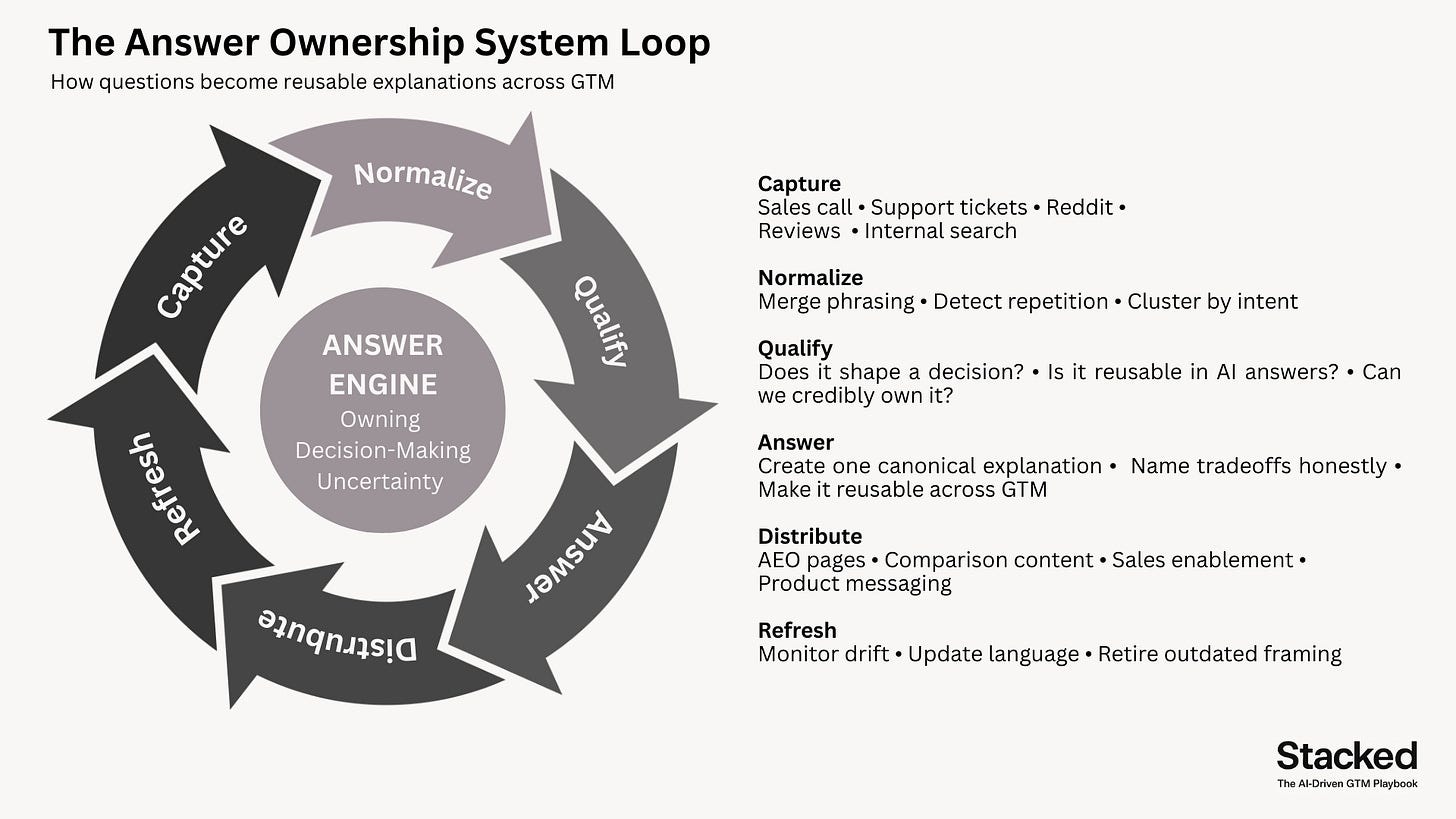
👀 My 2 Cents:
AI rewards clarity, not volume. Winning teams don’t publish more content; they “own the explanation” those shapes buying decisions everywhere but on their website. The question to ask your teams: “What are the 10 real questions that are blocking our prospects—and do we have a clear, public answer for each one?” If not, someone else is answering for you. I really enjoyed this “Strategic Guide” content, which redefines marketing as a discipline of narrative appropriation. And it gives a fresh perspective to your content strategy: no more traditional content, and no more traditional platforms either.
Stacked: The AI-Driven GTM Playbook
🟣 ChatGPT searches in English. Even when you don’t.
Peec AI analyzed over 10 million ChatGPT prompts. The result: in 78% of non-English sessions, ChatGPT supplements its search with English-language sources. 43% of all its “fan-outs”—the subqueries it generates in the background to build its response—are performed on the English-language web.
Specifically: a German user who asks in German for the best German software companies receives a list… without a single German company. Allegro, the undisputed leader in e-commerce in Poland, doesn’t appear when a Pole asks for the best shopping platforms. In Spanish, for a question about cosmetic brands, ChatGPT reformulated the query by adding the word “global” on its own.
Why? English-language content has more backlinks and more citations. ChatGPT interprets this as authority. The English-language web represents 50% of available content. Less risk, more sources.
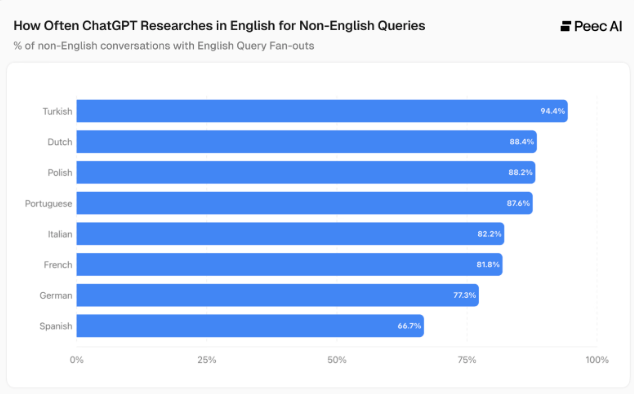
👀 My 2 Cents:
Dominating your local market is no longer enough if you’re invisible in English. It’s not about systematically translating your website. It’s about strategically appearing on the English-language sources that ChatGPT considers authoritative in your industry: media outlets, lists, and comparison sites. If these sources don’t mention you in English, you’re invisible to half of all AI searches—even in your own country.
📎 Peec AI — ChatGPT searches in English, even when you don’t
🟣 Google indexes and ranks new sites in 3-4 weeks: the 6-month timeframe is outdated - Max Roslyakov debunks the myth of “6 months to see SEO results” by demonstrating that with Google’s current indexing speed, a new site should show signs of traction (entering the top 20-50) within 3-4 weeks of starting content and link-building efforts. When will we see transparency from agencies and rapid validation of strategies...?
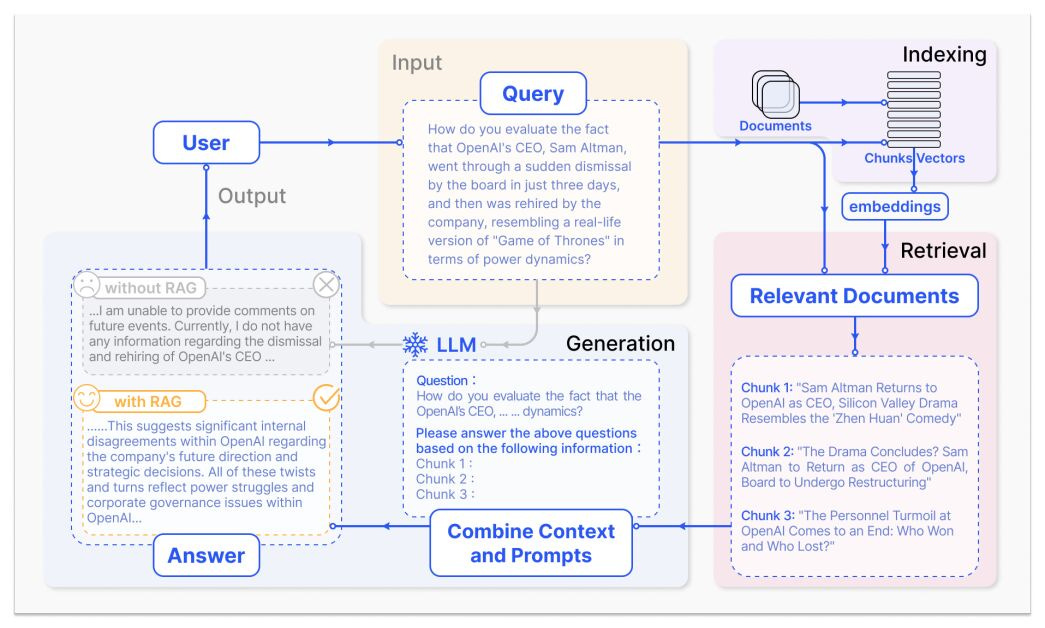
🟣 LLMs do not “favor” anything: understand the difference between prediction and information retrieval.
Britney Muller debunks a common misconception about how LLMs work by explaining the fundamental distinction between statistical token prediction and information retrieval via RAGs. This technical yet accessible post reminds us that optimization should target traditional search engines and presence in training data (via third-party media coverage), rather than simply claiming to “optimize for AI” directly. In other words, your SEO fundamentals are necessary—but no longer sufficient.
⚡ GEO Tactics Pulse
GEO tactics from the field, tested and shared by experts
🟣 Google is improving link visibility in AI Overviews and AI Mode. On desktop, a pop-up appears on hover displaying the site name, favicon, and a short description. Link icons are also becoming more descriptive and visible on mobile. Background: A Pew analysis revealed that users clicked on a link in AI Overviews in only 1% of visits, and the click-through rate (CTR) of the first organic result dropped by 32% after the rollout of AI Overviews. Google is iterating. It’s not a done deal yet—but it’s a sign that publisher pressure is starting to have an impact.
👉 To Do: take care of your favicon, your domain name and your meta description — these are now your first arguments for clicks in the AI interface.
🟣 Opting out of AI Overviews: no “off” button for a long time — here’s what it means - In February, Google officially confirmed that allowing publishers to opt out of AI Overviews is a “huge engineering undertaking.” The message is clear — don’t expect a quick fix. You don’t have an on/off switch. It’s better to optimize for good rankings than to try to avoid them. Three strategic signals to remember: 1) Traffic isn’t decreasing — it’s redistributing itself to more diverse sources. This is data confirmation of the Search Everywhere Optimization challenge: the traffic is still there, but it’s no longer going to the same players. The winners are those who have diversified their points of presence. The others have bet everything on Google alone.
And the real, quiet, explosive news: Google is preparing a feature in Gemini that will prioritize links to publishers with whom the user has an active subscription—with a rollout planned for later in AI Overviews and AI Mode. Direct translation: your subscriber base becomes an AI visibility lever. Audience loyalty is no longer just a business issue—it’s a GEO issue.
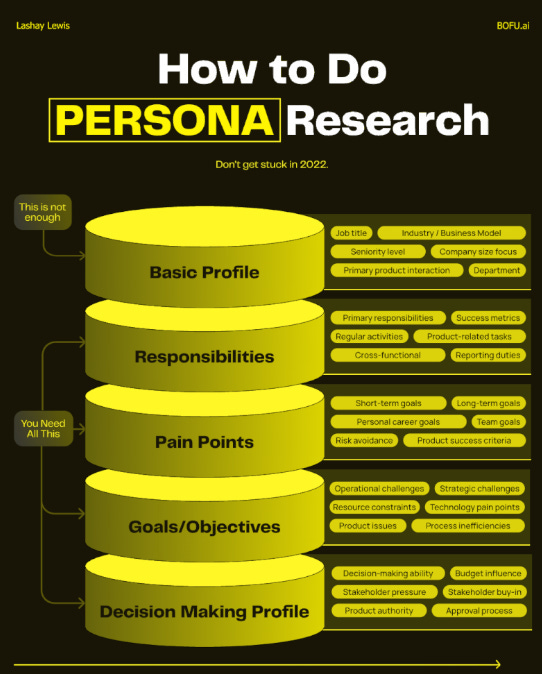
🟣 How to research your Personas - the new keyword research of the LLM era.
In Google, you start with keywords. In LLMs, you start with pain points. Queries are longer, more contextual, more conversational—they describe a problem, not a search term. The 3-step method: 1. Identify your persona’s real pain points—not the terms they type, but what keeps them up at night. 2. Dive into your internal documents: sales call transcripts (the goldmine), closed/won data, ICP records. 3. Build a precise query profile: who is this person, what are their responsibilities, their objectives, their decision-making process?
👉 To Do: The words a prospect uses to describe their problem in a sales call are likely the same ones they use when asking a lead manager. Use them to structure your content. Your sales calls are your best keyword research for the age of AI search.
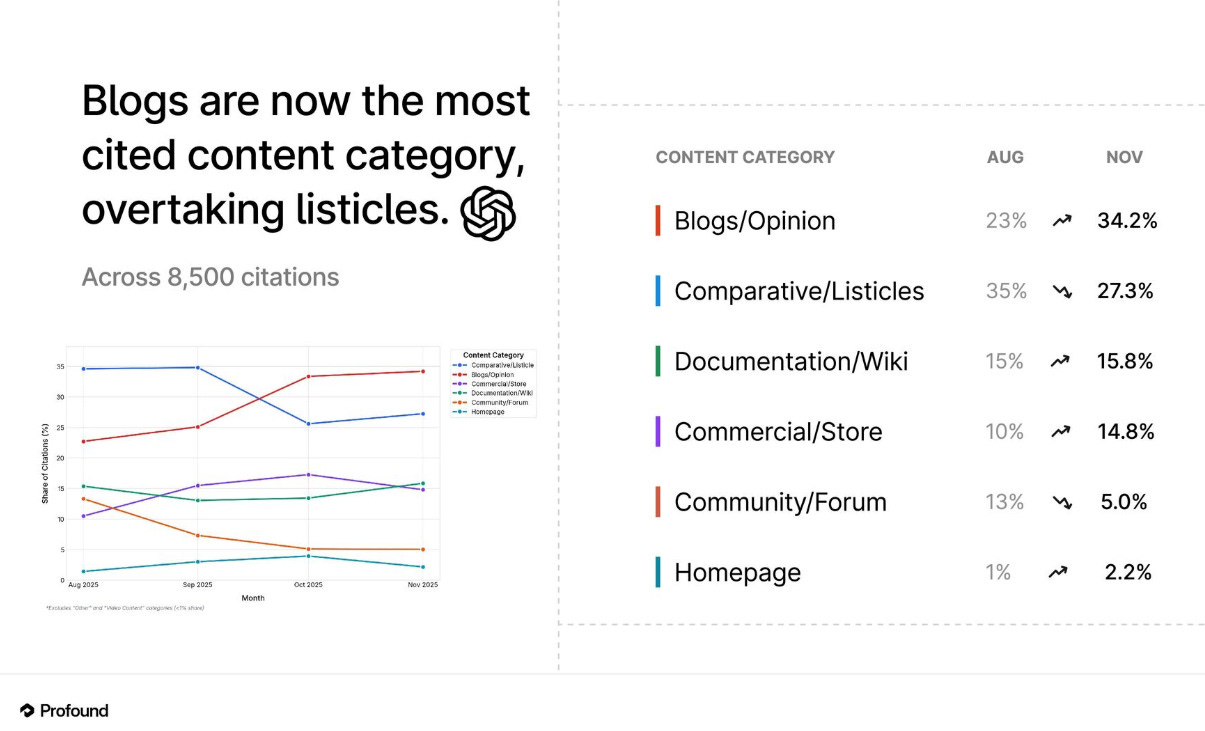
🟣 The killer news - “List” and “listicle” content is losing ground in AI citations. Opinion blogs are taking over.
The data is clear and consistent: blogs and opinion pieces have jumped from 23% to 34.2% of AI citations. Lists, on the other hand, have fallen from 35% to 27.3%. Blogs are now the most cited content category by LLMs—ahead of lists. And this isn’t an isolated signal: Lily Ray confirmed the exact same trend in traditional Google Search. Self-promotional lists are being re-evaluated simultaneously in both classic SEO and AI Search. Same direction. Same story.
👉 To Do: If your content strategy relies heavily on “Top 10 lists” and other listicles, it’s time to rebalance. LLMs prioritize content that expresses a point of view, demonstrates expertise, and takes a stand. A well-argued opinion blog now outperforms an exhaustive list—in both Google and ChatGPT.
📎 Is Google Finally Cracking Down on Self-Promotional Listicles?
🟣 LLMs cite 44% of content from the top 30% of the text: the era of the “Bottom Line Up Front” – Kevin Indig reveals an analysis of 18,012 verified ChatGPT citations that overturns 20 years of SEO dogma. The result: 44.2% of citations come from the top 30% of the text, with a “ski jump” effect thereafter. Information at the bottom of the page (90-100%) represents only 6.9% of citations. LLMs favor the journalistic “Bottom Line Up Front” structure: definition/immediate answer at the top, details below. Burying key information deep reduces the citation probability by 2.5x. A radical reversal of the “ultimate guide” paradigm with long introductions.
🟣 How to Choose the Right Prompts to Monitor Your AI Visibility - Ahrefs has just published the definitive guide to prompt tracking. The key takeaway: don’t track individual prompts. Group them into topic clusters and analyze aggregated trends. The volatility of AI responses makes any prompt-by-prompt analysis unreliable. The best sources to identify what to track include your questions that already rank well in Google Search Console, Google’s “People Also Ask” section, Reddit discussions on your topics, and pages on your site that are already generating traffic from LLMs. Last but not least, and this one is crucial: verify if what the LLMs are saying about your brand matches reality. Consider pricing, features, and competitive positioning. Ahrefs discovered that ChatGPT was indicating that their prompt tracking tool didn’t exist—even though it had just launched. They had to create specific content to correct the error.
👀 My 2 Cents:
A tracker is only valuable if you have an action plan behind it. Identify the sources most frequently cited in your responses, build relationships with them, and correct inaccuracies about your brand. Otherwise, it’s just a dashboard for the sake of a dashboard.
📎 Ahrefs — How to Choose the Best Prompts to Monitor Your AI Search Visibility
🟣 Building on the idea that “prompt tracking” is the best way to monitor your visibility, there’s also “prompt research”: the new keyword research in the age of AI Search.
Semrush makes a clear distinction: most prompts sent to AI generate explanations, not recommendations. However, your brand visibility only matters when the AI compares options and identifies a winner. That’s what a BOFU prompt is. “What’s the best project management tool?” → educational. “Which project management tool is suitable for a team of 10 people with a limited budget that integrates Slack?” → here, the AI makes a recommendation. This is the only moment that matters for your visibility.
👀 My 2 Cents:
Previously, there were seven steps to designing a content strategy; now, you can say you have four: 1) define your personas based on their constraints (budget, risk, context), 2) identify the product attributes that trigger AI recommendations, 3) use keyword research as a source of natural language, and 4) then generate clusters of BOFU prompts via LLM. The guiding principle is the golden rule: 10 well-chosen prompts per product are enough to determine whether the AI recommends you—or ignores you.
📎 Semrush — How to Do Prompt Research for AI SEO
🟣 Your AI doesn’t know your customers. Teach it. 5 prompts to generate your AI Personas - Andy Crestodina (Orbit Media) makes a simple observation: a generalist AI produces generic marketing recommendations because it has been trained on the average web user. If you don’t teach it who your ideal customer is, it will give you answers that apply to everyone—and therefore to no one.
👉 To Do: Create an “AI buyer persona”—a detailed profile of your ideal customer that you inject into every marketing prompt. No age, no hobbies. What matters: their concrete challenges, their fears, their decision criteria, what motivates them to take action. Once created, this persona becomes a reusable knowledge block. You can upload it to any LLM to audit a web page, generate CTAs, predict how your buyers search for your AI solutions, or challenge a sales pitch.
👀 My 2 Cents:
Ask your AI persona to list the 25 prompts it would use to search for a service provider like you in ChatGPT. Then test these prompts. Does your brand appear? If not, you know where to focus your geo-optimization efforts.
📎 Orbit Media — How to Create AI Personas: 5 Prompts for Smart Marketing Alignment
🟣 LLM SEO: Unexpected Content Formats That Make a Difference - Vijay Jacobs shares a client case study: 10.5 million impressions and 622,000 clicks in 12 months for a SaaS, with SEO becoming their primary revenue stream. What’s interesting here isn’t the numbers—it’s what he says about the formats. Two original ideas to remember for your LLM content strategy: 1) AI-powered podcasts as a backlink lever. Generate podcast episodes using AI, syndicate them at scale on podcasting platforms, and reap a massive number of authoritative backlinks. LLMs index transcribed audio content. It’s an underutilized format, and therefore faces little competition. 2) “AI-powered knowledge files.” Create structured documents specifically designed for LLMs to recognize and recommend your brand. The idea: not to wait for AI to “discover” your brand by inference — directly provide it with the raw material to understand and quote it.
👀 My 2 Cents:
This post confirms a fundamental trend: optimizing for LLMs is no longer simply about “writing well for Google.” It’s about thinking in terms of the formats that LLMs consume, understand, and render. Structured knowledge files—llms.txt, highly detailed FAQ pages, industry-specific glossaries—perfectly fit this logic.
In my GEO masterclass, I help you redefine your content strategy to move from producing volume (to cover keywords) to a strategy of “source coverage” and relevance engineering. The next session is at the end of March; you can join the waiting list here 👇👇 .
🤔 SEO vs GEO: The Great Debate
The naming and paradigm war continues
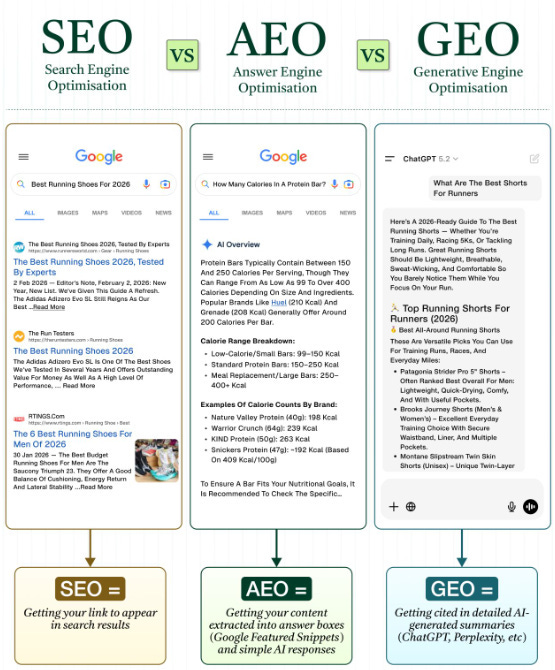
🟣 Yet another explanation of the differences between AEO, GEO, and SEO
Chris Donnelly explains that the majority of businesses still optimize solely for SEO, ignoring the fact that the game has changed: visibility is now fragmented into three layers. SEO (appearing in traditional search results), AEO (being featured in Google’s answer boxes and short AI responses), and GEO (being cited in the detailed AI responses of ChatGPT, Perplexity, Gemini, and Claude). According to him, brands that optimize for all three simultaneously structure their content for indexing, build authority for citations, and strengthen their SEO foundations.
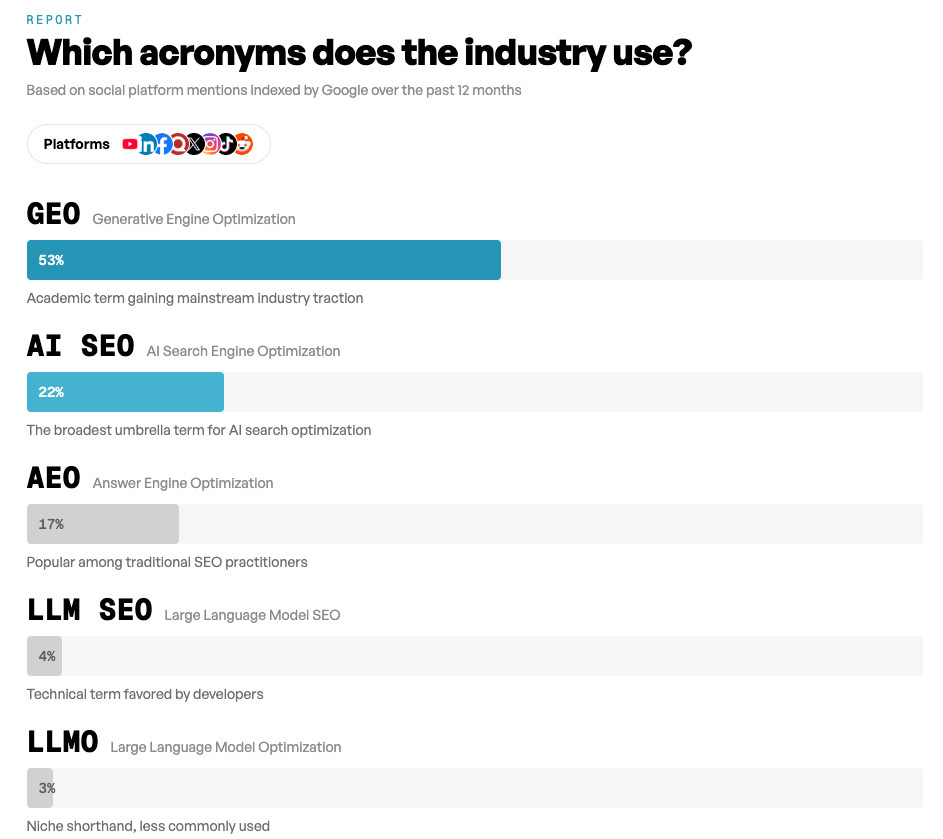
🟣 The verdict seems to be in: The acronym GEO crushes all the others…
One website had the brilliant idea of measuring what no one else was really measuring: which of these acronyms—GEO, AEO, AI SEO, LLM SEO, LLMO—is actually used by the industry? Not in opinion pieces. On real social media platforms: YouTube, LinkedIn, Reddit, X, TikTok, Instagram, Facebook, Quora.
→ Result over 12 months of data: GEO dominates at 53%, followed by AI SEO at 22%, AEO at 17%, and LLM SEO and LLMO together do not exceed 7%.
→ Even more striking: GEO is at the top on every platform without exception. Not a single one where another term surpasses it.
Here are some interesting nuances for you, decision-makers:
LinkedIn is the focus of the debate — with over a million mentions in total. It’s where marketers clash over naming.
AI SEO performs particularly well on YouTube, at 37% — content creators prefer the most “searchable” term.
LLM SEO and LLMO exceed 10% only on Reddit and X — the domain of technicians, not decision-makers.
🛠️ AI Search Tools & workflow
Tools for taking action (priority given to free tools)
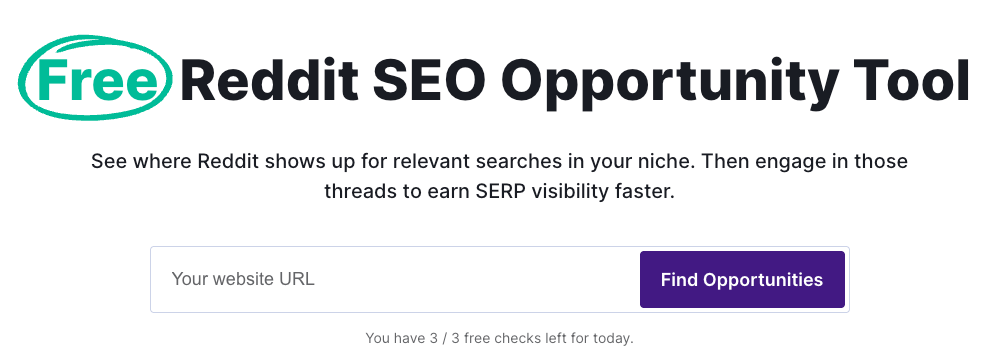
🟣 Backlinko Launches Free Tool to Leverage Reddit’s SEO Dominance - Leigh McKenzie announces the launch of a free tool from Backlinko that solves an emerging SEO problem: Reddit dominates Google’s first page, but marketers don’t know which threads to engage with. The tool identifies keywords where Reddit already ranks, threads with high organic traffic, relevant subreddits, and even suggests well-timed non-commercial comments. This initiative recognizes a new reality: Reddit has become an essential search platform, and the tool democratizes access to this often-overlooked SEO opportunity.
🟣 Glippy: The Audit Tool to Optimize Readability for LLMs and AI Agents - Jan-Willem Bobbink announces the completion of Glippy, an analysis tool that evaluates over 80 factors impacting LLM crawler capabilities, AI readability, and agent readiness. Covering everything from basic robots.txt to advanced HTML semantic analysis and structured data, the tool promises a systematic approach to AI optimization. While awaiting Google approval of the Chrome extension, a desktop application is in development for agencies requiring massive multi-domain analyses, illustrating the increasing professionalization of the AEO sector.
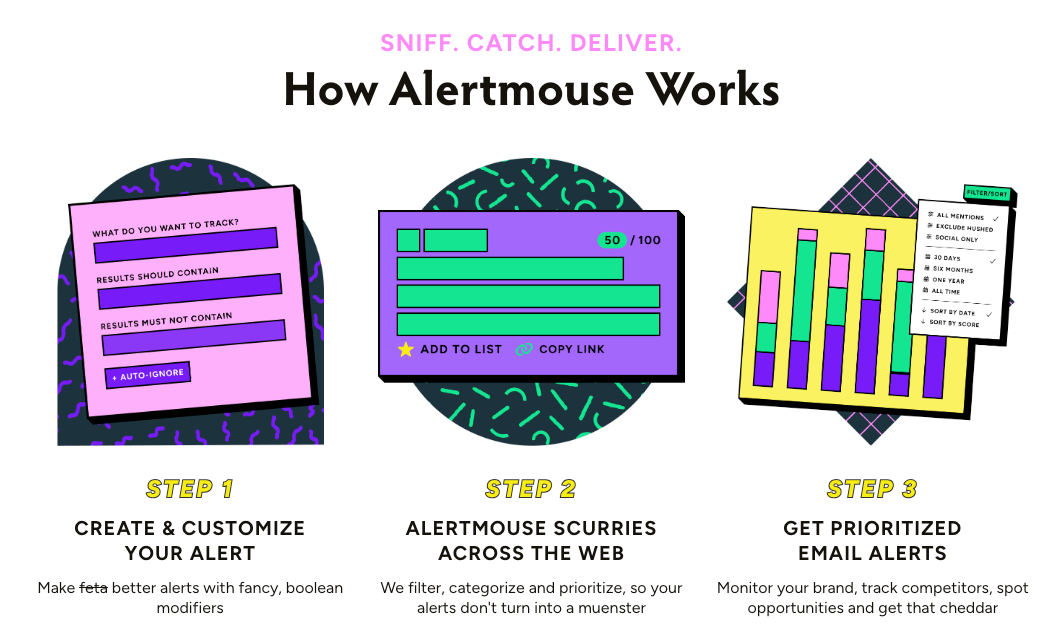
🟣 Alertmouse: the smarter version of Google Alerts - Launched in late 2025 by Rand Fishkin, Alertmouse is what Google Alerts should have remained: simple, reliable, and truly useful. The principle? You enter the terms you want to monitor (your brand, a competitor, a topic), and Alertmouse sends you a clean, prioritized daily or weekly email digest of all mentions found on the web—including Reddit and social media. What sets it apart: where Google Alerts generates noise or returns very little, Alertmouse filters, categorizes, and prioritizes mentions. No AI under the hood, no VCs—just a well-designed tool, by humans, for humans.
👉 Why this is relevant to your GEO strategy: Monitoring mentions of your brand on third-party sources (media, forums, Reddit) is no longer optional—it’s the core of the strategy. These are the mentions that LLMs use to determine if you’re a credible authority in your industry. Pricing: Free (1 alert)—paid plans starting at $10/month.
🟣 OpenSEO: the free alternative that threatens the Semrush-Ahrefs duopoly thanks to third-party APIs - Corey Northcutt, co-founder of Orbit Media with Andy Crestodina, presents OpenSEO, one of the many free alternatives to Semrush and Ahrefs that have recently emerged, made possible by the DataForSEO API. He explains how Ahrefs and Semrush have long charged for their APIs to stifle competition, but that solutions like DataForSEO now allow for the creation of competitive interfaces at a lower cost. His team still uses the two established tools but finds DataForSEO irreplaceable for large companies, opening up the debate on the evolution of SEO SaaS.
👉 OpenSEO
📅 Bonus - Agenda: Content & AI Search conferences not to be missed in 2026 in the US
For those who want to step away from their screens and connect with the American AI Search community, Ahrefs has just published a list of 12 must-attend content marketing conferences for 2026. Key dates:
Content Jam — April 22-23, Chicago. Day 1 kicks off with a 4-hour workshop led by Andy Crestodina… and me 🙋♀️ . Limited to 70 people. We ‘ll be meeting by Lake Chicago and having dinner with the women in my AI marketing community and the other speakers from the event.
Social Media Marketing World — April 28-30, Anaheim. 1900 attendees, zero sales pitches guaranteed — they display it and apply it.
INBOUND — September 16-18, Boston. HubSpot’s flagship event. 200+ speakers, 150 countries represented.
Content Marketing World — October 5-7, Denver. 3400 participants, THE leading conference for global content marketing.
Ahrefs Evolve San Diego — October 12-13. Intentionally intimate format: 500 participants max, practitioners on stage, no theory.
👉 The full list is available on the Ahrefs blog.
👋 That’s all for this month! Thanks for reading. I’ll see you again at the end of March/beginning of April in the same format. Until then, your opinion on this edition would make me… 🤸 🤸 .